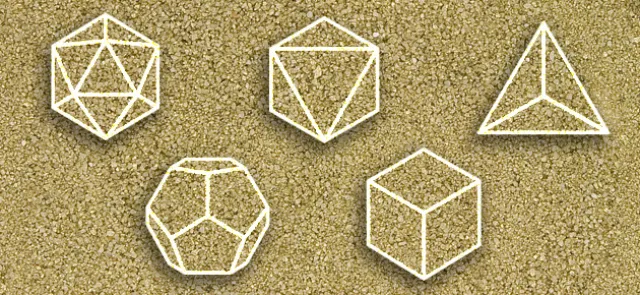
Cauchy proved that all convex polyhedra are rigid (see "Early discoveries"): if we build a convex polyhedron whose faces are steel plates and whose edges are hinges, its shape cannot be changed, just as if the hinges had been welded together. This is why scaffolding made up of convex polyhedra is stable!
There is, however, a highly restrictive assumption in Cauchy's theorem: the solid must be convex. The question naturally arose as to whether, and to what extent, this assumption could be dropped. In Cauchy's time, every known polyhedron was rigid, so was there a theorem lurking behind this? Cauchy himself investigated the matter but was unable to reach a conclusion.
Partial counterexamples
------------------------
In 1898, Raoul Bricard (1870–1943) was the first to exhibit a polyhedron that was both non-convex and flexible: the Bricard octahedron. If the polyhedron is realized as rods hinged together at the vertices, it can flex. There was just one small disappointment: its faces intersected one another. Bricard then discovered a second flexible octahedron, but its faces still crossed one another.
In 1900, Max Brückner described rings of tetrahedra in his monumental work Vielecke und Vielflache, an idea that would subsequently be rediscovered several times. These consist of regular tetrahedra joined together along their edges. With at least six tetrahedra, the chain can close up on itself and move. With eight or more, the ring can even rotate indefinitely. But can we still call it a polyhedron when its constituent parts are held together along an edge?…