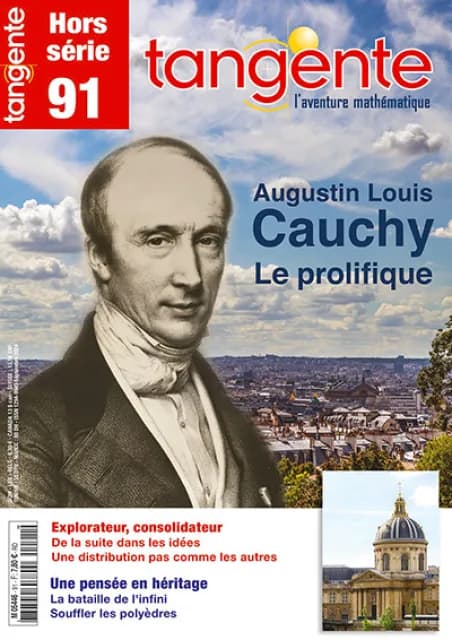
Augustin Louis Cauchy
This issue is not fully translated into English yet; only translated content is shown.
Read the French versionAll folders in this issue

To begin

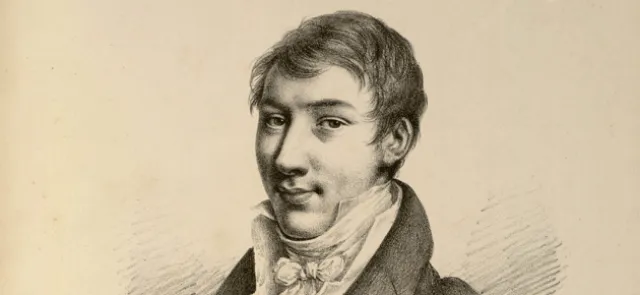
A mathematician with a wealth of ideas
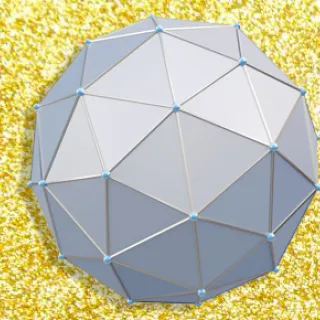
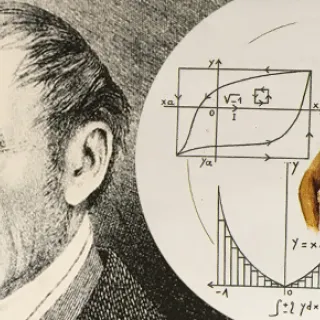
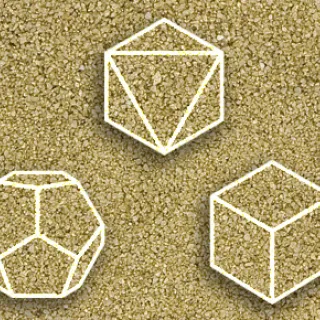
How can one hope to cover the entire body of work of one of the most prolific mathematicians in history? One of Cauchy's great merits is to have brought analysis into its modern vision, clarifying an entire branch of mathematics that had experienced tremendous growth thanks, among others, to Euler, Lagrange and Laplace. But Cauchy also revived venerable domains such as the theory of polyhedra, and created new ones such as complex analysis. He was also among the first to explore what we now call group theory. Alongside the consolidating Cauchy, there lived an exploratory Cauchy, and it is to these two facets of his scientific personality that we are equally indebted today.
At the heart of his century
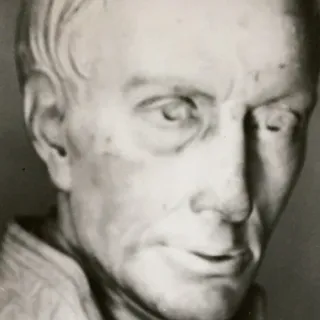
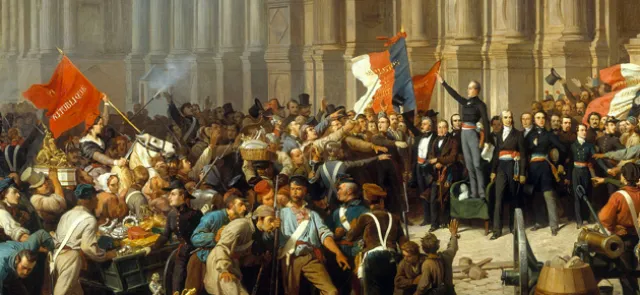
In this city of Paris, which could then claim the status of intellectual capital of Europe, Cauchy was the scientific pivot of his entire generation. Cauchy's glory was however nothing like a long tranquil river. Born in 1789, he was confronted with the great upheavals that swept through France for decades and saw regimes and revolutions chain one after another. If no one in his time truly contested Cauchy's scientific domination, his genius did not always protect him from the hazards of the era. His sometimes intransigent firmness on political and religious matters worked against him, giving him the image of a rigid man even as his charitable works also earned him great respect.


An omnipresent legacy
If summarizing Cauchy's multifaceted work is difficult, detailing the extensions to which his work has given rise to is impossible, so profound has his influence been. Cauchy's name is absolutely everywhere in higher mathematics: Cauchy's criterion, Cauchy's distribution, Cauchy's problem, the Cauchy-Schwarz inequality, not to mention of course the various Cauchy theorems. All these denominations bear witness to a legacy that has permeated all of mathematics. And if it happens that, thinking of one or another of the great figures of his era, the names of Galois or Gauss come first to mind, Baron Cauchy is no less one of those rare mathematicians of whom it can be said that, in all fields, there is a before and an after him.