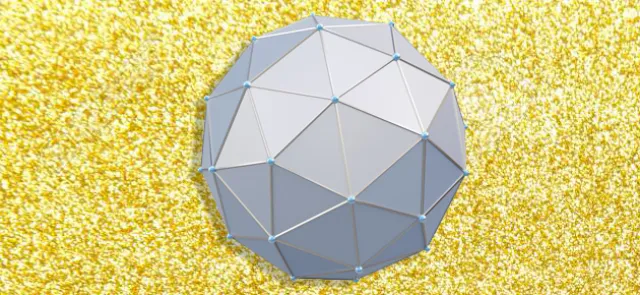
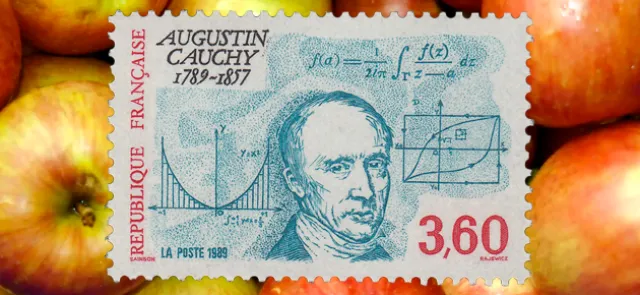
After his first paper on polyhedra was warmly received (see the article "First discoveries"), Cauchy wrote a second paper, read at a meeting on January 20, 1812. Its central theorem states: "Two convex polyhedra are congruent if they have the same number of faces, with corresponding faces congruent." Intuitively, this forces every convex polyhedron to be rigid (assuming it is made of rigid bars): if the angles between its edges could be altered, this would produce a new polyhedron that could remain convex while having the same faces, contradicting the theorem.
Cauchy's original statement subsequently gave rise to numerous generalizations and continues to inspire research. Several nonconvex, flexible polyhedra were constructed in the 19th century, often with self-intersections. The subject saw a revival in the second half of the 20th century, first with Connelly's sphere and then with the bellows conjecture (see the article "Inflating polyhedra").
Two corollaries already in Euclid!
------------------------------------
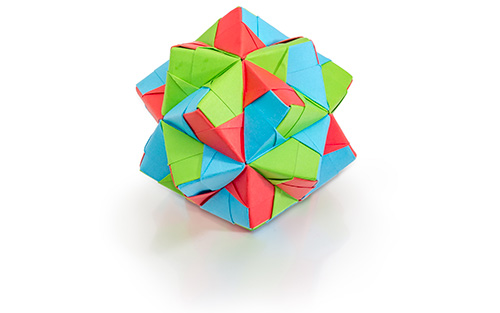
The theorem Cauchy presented in his paper is more general than a rigidity result and allowed him to derive two important corollaries: "Two convex polyhedra with the same number of congruent faces arranged in the same way are either congruent or mirror images of one another; in either case, they are necessarily congruent" and "When two convex polyhedra have the same number of similar faces arranged in the same way, the second is similar either to the first or to a third polyhedron that is the mirror image of the first."
Curiously, both results were implicit in two definitions in Book XI of Euclid's The Elements (Definitions 9 and 10), as Cauchy himself observed, politely noting that the results were "contained" within them. Thus, two thousand years later, the "definitions" became theorems.
Proofs with problems
-----------------------
Although his papers are remarkably clear, Cauchy had some difficulty convincing the academician Étienne Louis Malus (1775–1812) that his proofs were valid. Fortunately, Legendre, Carnot and Biot, who examined his report as members of the committee, showed great enthusiasm. This brought the young Cauchy considerable prestige and gained him entry to the Société philomatique, an important step toward eventual membership of the Académie des sciences.
Without realizing it, however, Malus was not entirely wrong. In the 1920s, the German mathematician Ernst Steinitz (1871–1928) identified—and then corrected—an error in Cauchy's original proof. This did not prevent the algebraic topologist Hans Freudenthal (1905–1990) from regarding the rigidity theorem as Cauchy's most significant contribution to geometry.