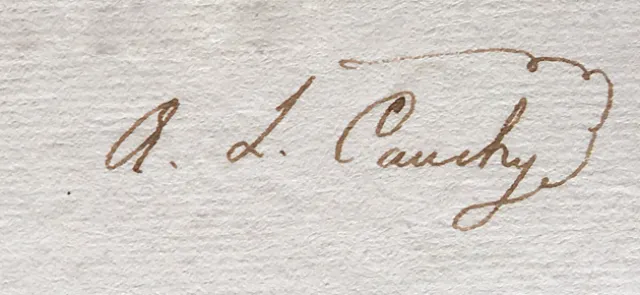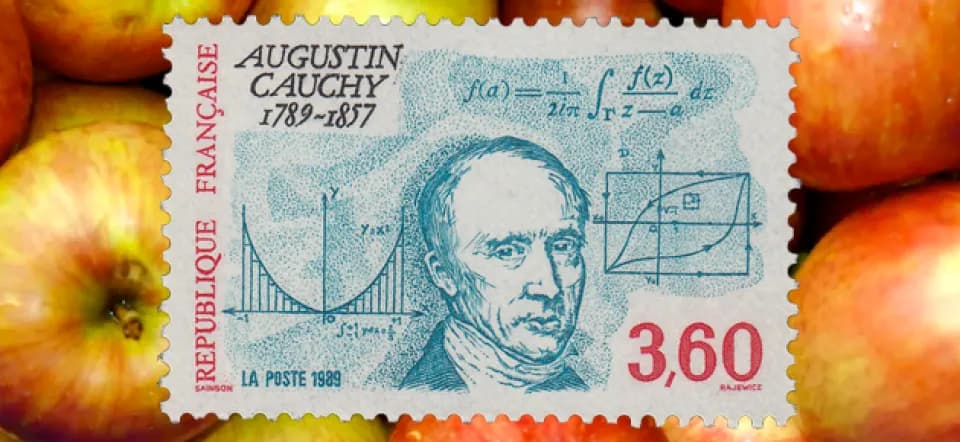
In the 1770s, mathematicians Edward Waring (1736–1798), Joseph-Louis Lagrange (1736–1813) and Alexandre-Théophile Vandermonde (1735–1796) developed the theory of permutations, viewed as rearrangements of the roots of an equation. This became a central tool in their study of the algebraic theory of equations. Waring failed to achieve lasting recognition despite his numerous but obscure works, while Vandermonde took his first steps in mathematics with symmetric functions; it was Lagrange who laid the foundations of Galois theory (see our special issue 80, Les Groupes (Groups), 2021). Permutation theory then advanced in the early 19th century through the work of Paolo Ruffini (1765–1822) and Augustin-Louis Cauchy (1789–1857).
####
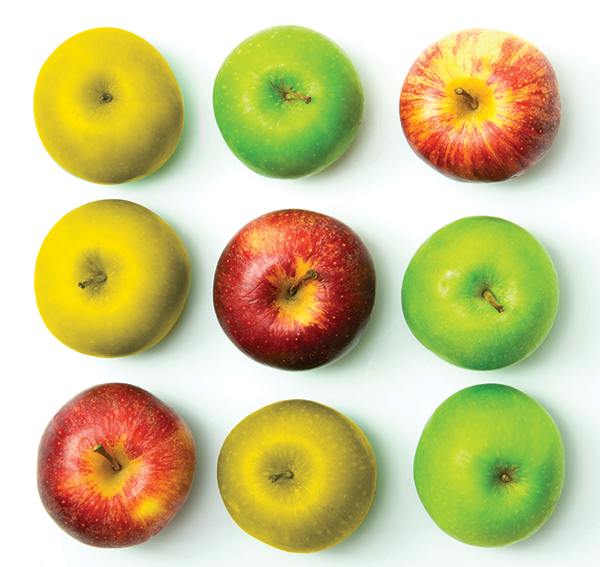
Permutations of three apples (one yellow, one green and one red).
Substitutions as Cauchy saw them
---------------------------------