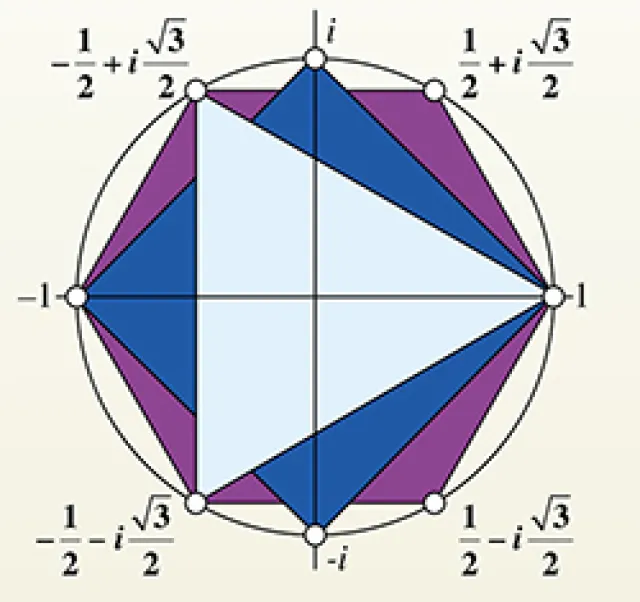




The n th roots of unity
------------------------------------------
These numbers are aptly named: given a nonzero integer n, the *nth roots of unity are all the complex numbers whose n th power equals 1. In other words, if we denote them by z, they satisfy the equation *z n* = 1.
For a given n, there are exactly n nth roots of unity. A short calculation in ℂ shows that they can be expressed using the complex exponential: for 0 ≤ k ≤ n − 1, they are the numbers
For example, if n = 2, both roots are real: unsurprisingly, we get 1 and −1.
For n = 3, they are known as the cube roots of unity: in the standard notation, they are 1, and since j 2 is the square of j.