



The resolution of algebraic equations
At the time when Galois began to take an interest in mathematics, polynomials had long been studied, and substitutions and permutation groups had already been introduced by Lagrange and studied by Cauchy. Ruffini and Abel had previously proven that it is generally impossible to solve polynomial equations of degree 5 or higher algebraically. So what is Galois's contribution? Beyond solving a problem, he opened a new field of mathematics by showing how much a group could encode the fundamental properties of a polynomial.
All articles in this folder
Before Abel and Galois
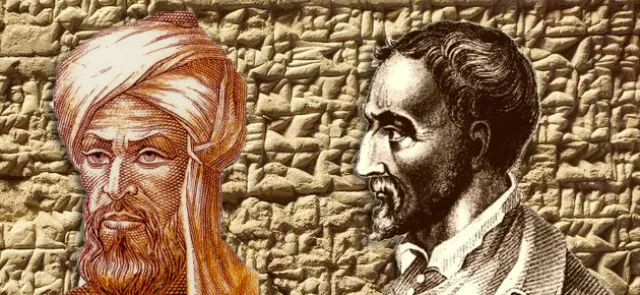
Until the end of the 18th century, algebra was essentially about solving algebraic equations. That chapter in the history of algebra closed with the work of Abel and Galois. Before them, what questions occupied mathematicians? What problems could they hope to solve?
Cauchy, a forgotten pioneer
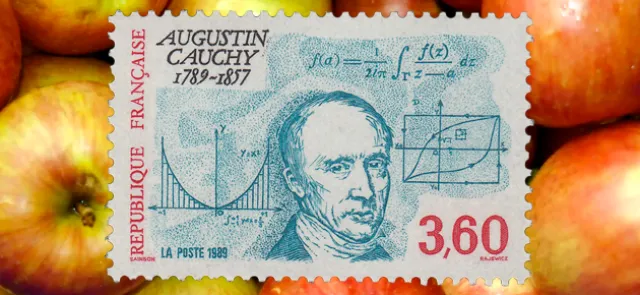
Because Augustin-Louis Cauchy did not take a direct interest in solving algebraic equations, he is an overlooked figure in the history of group theory. Yet his research on permutations provided valuable tools for those who worked on Galois theory.

Two geniuses, two approaches
Two methods are known for proving that the general quintic equation cannot be solved: Abel's method, presented in 1824 and refined in 1826, and Galois's method from 1829–1830. Galois theory is fairly well known, whereas Abel's ideas are less often discussed.

Tales of roots
The roots of unity form an abelian group. A quick refresher...

Beyond Lagrange's memoir
As a teenager, Galois read Legendre and Lagrange, followed by Gauss and Cauchy. He often cites the latter two, but rarely Lagrange. Galois was clearly influenced by Lagrange's ideas; he would, however, go much further, benefiting from all the advances made since 1771.

The building blocks of Galois theory
Although inspired by Galois's work, "his" theory developed long after his death and did not take off until algebraic structures were introduced.

Hilbert's thirteenth problem
At the second Congress of Mathematicians, held in Paris in the summer of 1900, David Hilbert presented a list of research questions that he considered important. The list contains twenty-three problems spanning every field: algebra, geometry and analysis.