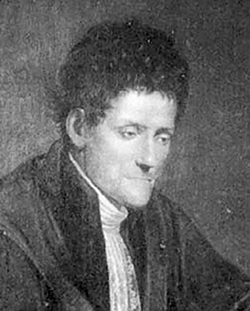
Paolo Ruffini (1765–1822).

Two methods are known for proving that the general quintic equation cannot be solved: Abel's method, presented in 1824 and refined in 1826, and Galois's method from 1829–1830. Galois theory is fairly well known, whereas Abel's ideas are less often discussed.


Articles recommended for you.

As a teenager, Galois read Legendre and Lagrange, followed by Gauss and Cauchy. He often cites the latter two, but rarely Lagrange. Galois was clearly influenced by Lagrange's ideas; he would, however, go much further, benefiting from all the advances made since 1771.

Following his work on solving fourth-degree equations, Lagrange turned to the fifth-degree case. It was not until Abel that these equations were shown not to be solvable by radicals. Galois would provide a necessary and sufficient condition for an equation of any degree to be so solvable. In doing so, he founded group theory.

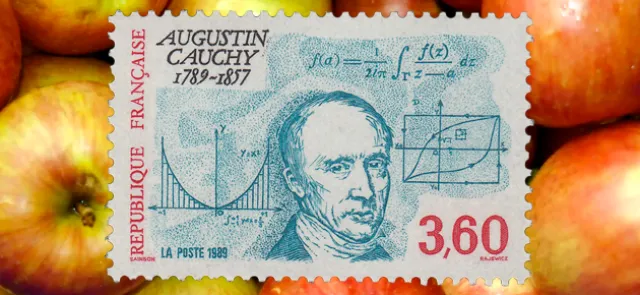
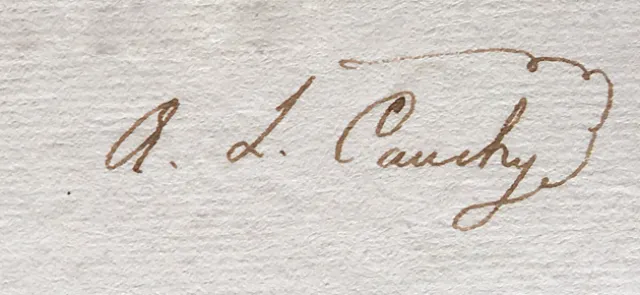
Because Augustin-Louis Cauchy did not take a direct interest in solving algebraic equations, he is an overlooked figure in the history of group theory. Yet his research on permutations provided valuable tools for those who worked on Galois theory.

As early as 1770, Joseph-Louis Lagrange took an interest in solving polynomial equations. He wanted to understand why cubic and quartic equations could be solved by radicals. This led him to study permutations of their roots.
Discussion
Sign in to post a comment and talk with other readers.
No comments yet. Be the first to respond.