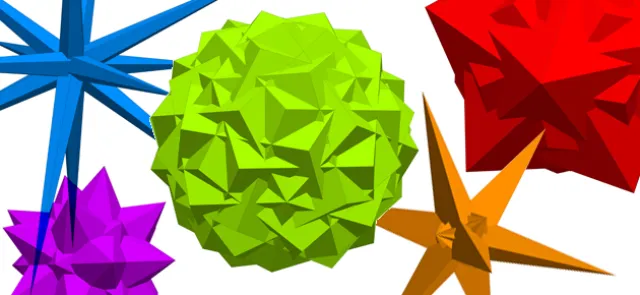
In a polyhedron, the numbers of vertices S, faces F, and edges A generally satisfy the relation S + F = A + 2, known as Euler's formula (see Tangente 174, 2017). This mathematical gem turns problems in geometry into problems in arithmetic, building a marvellous bridge between two worlds without regard for the objects' dimensions; the relation thus foreshadows topology.
It all began with Descartes
----------------------
In his text Progymnasmata de solidorum elementis ("Exercises on the Elements of Solids"), René Descartes (1596–1650) stated a theorem: the sum of the angular defects at the vertices equals eight right angles. The angular defect at a vertex is the difference between 360° and the sum of the angles of the faces meeting at that vertex.
For example, three equilateral triangles meet at each vertex of a regular tetrahedron. Since 3 × 60° = 180°, the angular defect at each of its four vertices is 360° − 180° = 180°. In a cube, three squares meet at each vertex. Since 3 × 90° = 270°, the angular defect at each of its eight vertices is 360° − 270° = 90°.
Descartes's theorem captures something every polyhedron enthusiast has noticed: the fewer the faces, the "sharper" the vertices. The angular defect at a vertex precisely measures how "sharp" it is. A cube is "less sharp" than a tetrahedron. Unfortunately, Descartes never published this result; it became known only in 1860, when Louis-Alexandre Foucher de Careil (1826–1891) made it public. A few years earlier, he had discovered it in Hanover, Germany, along with other manuscripts by Descartes, among Leibniz's mathematical papers.