Poincaré's sieve
Poincaré's sieve formula gives the cardinality of a finite union of finite sets in terms of the cardinalities of those sets and their intersections.


Poincaré's sieve formula gives the cardinality of a finite union of finite sets in terms of the cardinalities of those sets and their intersections.


Articles recommended for you.

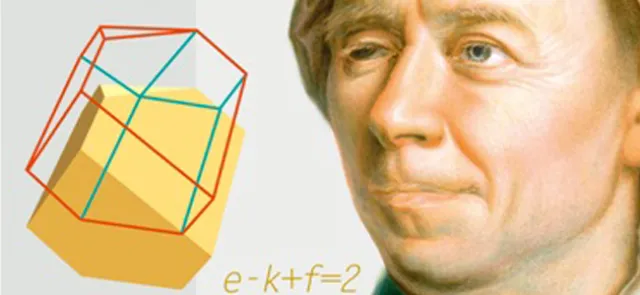
Euler’s formula, a fundamental relation in mathematics, offers an opportunity to explore the properties of objects in three dimensions—and in higher dimensions as well. Along the way, we will encounter a classic of operations research: the simplex algorithm.

Eugène Charles Catalan (1814–1894), the son of a Parisian jeweler, was born in Bruges, Belgium. A brilliant student, he entered the École polytechnique in 1833, where he befriended a teaching assistant who would later become famous: Joseph Liouville.

Triangles and quadrilaterals have inspired a wealth of mathematical literature. Yet few people seem to have taken a close interest in pentagons before a certain Carl Friedrich Gauss, who gave us a little gem for calculating their areas.

Duality has appeared in many branches of mathematics, from the Platonic solids of antiquity onward. It came into its own in projective geometry in the early 19th century, emerged soon afterward in logic with George Boole and Augustus De Morgan, and later flourished in linear algebra.
Discussion
Sign in to post a comment and talk with other readers.
No comments yet. Be the first to respond.