The well-understood surfaces of ordinary space
---------------------------------------
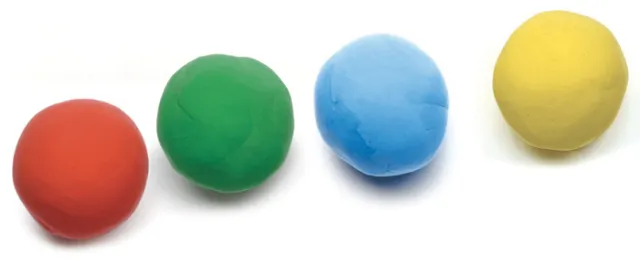
Among the surfaces in our space that are closed (in particular, bounded and "without boundary") and connected (that is, consisting of "a single piece"), we know which are homeomorphic to the sphere (that is, they can be deformed into a sphere if we imagine them made of a flexible material). These are the surfaces that are also simply connected: on them, every loop—that is, every closed, non-self-intersecting curve—can be contracted to a point (see the article Polyhedra: from Euler's formula to Poincaré's characterization).
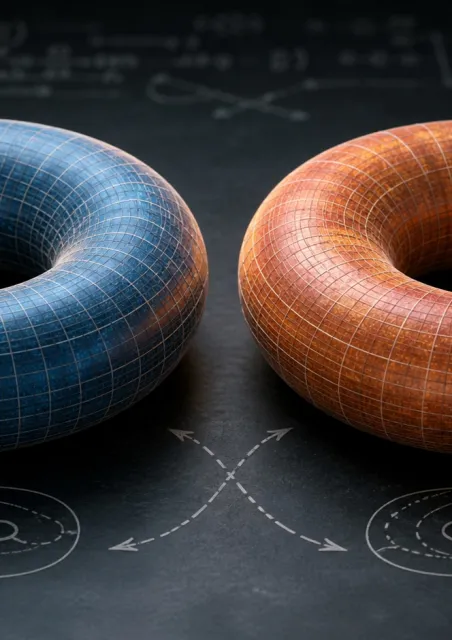
This is true of an ellipsoid of revolution or a soap bubble tossed about in the air. But it is not true of the torus (the surface of an inner tube or a doughnut): on a torus, some loops cannot be contracted to a point. The torus is therefore not homeomorphic to the sphere.
What about four-dimensional space? Poincaré's question
----------------------------------------------------------