Euclidean geometry (300 BC) rests on definitions of geometric objects (points, lines, etc.) and on five postulates, basic rules for working with these objects. The first postulate states, for example, that a line segment can always be drawn by joining any two points. The fifth, more complex, implies that for any line, through any point not on that line, there passes a unique parallel to the line. Here, lines are said to be parallel if their intersection is empty.
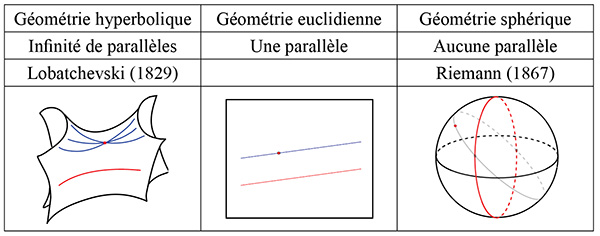
This fifth postulate long raised a question: could it be deduced from the four preceding ones? Finally, in the 19th century, it was proved that it was indeed independent. From this observation emerged two new types of geometry, which differ from Euclidean geometry in that this postulate is replaced. In hyperbolic geometry, for example, through a point there pass infinitely many parallels to a given line. To make this formal, we must redefine the notion of a line and step outside the framework of the Euclidean plane: that is the purpose of what follows.
Surfaces, distances and geodesics
In mathematics, a surface is an object that up close resembles a plane, just as the Earth appears flat at our scale. We can locate a point on a surface using two coordinates, like latitude and longitude on Earth: it is a two-dimensional object.