This article was originally published in Tangente 162. We are republishing it following the death of Maryam Mirzakhani.
---
Mathematicians who had gathered from around the world presented this award for outstanding work to Maryam Mirzakhani, a 37-year-old Iranian mathematician and professor at the prestigious Stanford University in California.
Writing to George Sand, Flaubert declared: "Man is nothing, the work everything!" So let us discuss Maryam Mirzakhani's work—or rather whet the reader's appetite, so rich and complex are the mathematical ideas involved, and so substantial is her body of work. References of increasing difficulty, listed at the end of the article, will satisfy curious readers.
Very briefly, Maryam Mirzakhani studied certain dynamical systems on geometric objects, focusing on two main settings.
In the first setting (that of a hyperbolic surface), the dynamical system under study is the geodesic flow on the surface: given a starting point and a direction, there is a unique way to proceed, by following the shortest path (the geodesic) determined—locally, and indeed globally—by that point and direction.
The question is how the trajectories behave in the future: are there trajectories that close up (called periodic), or even close up without crossing themselves (simple periodic)? What does the collection of these periodic geodesics tell us about the geometry of the surface? And so on.
The second setting (that of translation surfaces) concerns the vertical flow on the surface. Here we shall give only a very cursory account of it.
-
The stages of dynamics: topology takes center stage
----------------------------------------------------------------
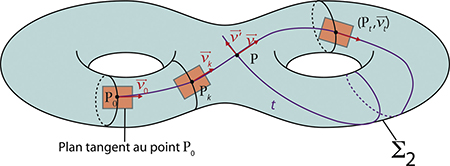
The "classification theorem for surfaces" is part of every budding mathematician's catechism: up to "continuous deformation" (without tearing), a "compact, orientable surface without boundary" is homeomorphic to one of the mathematical objects presented in the box A menagerie of orientable surfaces, each characterized by its genus g.
If n distinct disks are removed from a surface of genus g, the result is a surface of genus g with n boundary components or n ends, depending on whether the disks are open or closed. We denote any such surface by Σ*g,n (and write Σg when n* = 0).
We can construct Σg,n by gluing (identifying pairs of sides of a polygon). If the polygon has a metric structure—if we can measure distances between points, angles between vectors, etc.—the resulting surface inherits this metric structure, first locally (between nearby points) and then globally.
Geometric stages
--------------------
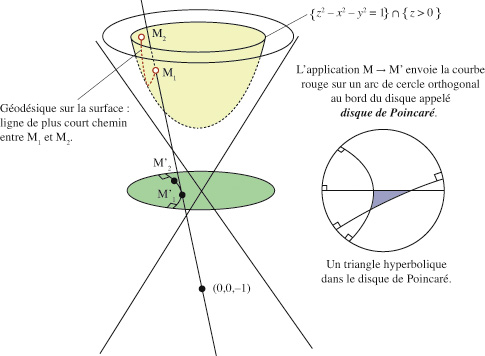
The upper part (lying in the half-space {z > 0}) of the two-sheeted hyperboloid of revolution with equation z2 – x2 – y2 = 1 is a surface whose tangent planes can each be equipped with an inner product, a structure well suited to intrinsic metric computations.
This surface carries a natural metric (called hyperbolic) that allows us to measure distances between points and angles between vectors in each tangent plane. For this metric, there is always a unique shortest path joining any two points: the intersection of the surface with a plane through O. Projecting the surface from the point (0, 0, –1) gives an open disk of radius 1. If the metric structure is transferred to the disk (called the Poincaré disk), the geodesics become circular arcs or diameters, all orthogonal to the boundary.
The metric in the second diagram is a Euclidean metric (with singularities). Take n vectors in the Euclidean plane 2, joined end to end in two ways so that the two resulting polygonal lines intersect only at their endpoints; together they form a planar polygon. By identifying the two copies of vector and declaring a reference direction (the vertical direction) to be part of the geometric structure, we formally construct a pair consisting of a surface without boundary and a distinguished direction. "Formally" because the genus of the surface can be seen by actually folding it, but we stipulate that the geodesics on this surface are line segments.
The surfaces constructed in this way are called translation surfaces because the maps defining the gluing are translations alone. This time the folding does not work smoothly: singularities form around the vertices identified with one another. Geometrically, we may say that negative curvature is concentrated at the images of the vertices where the singularities form.
-
Mirzakhani in the hyperbolic setting
-------------------------------------
There are infinitely many ways to equip Σ*g,n with a hyperbolic metric. These metrics are classified by the moduli space*, Mg,n, which does not distinguish between two metrics that are essentially the same (or isometric, as mathematicians say). For now, let us fix a metric on Σg,n.
Draw a continuous closed path (a loop) on this surface. By sliding the path over the surface, we can make it geodesic in exactly one way: mathematicians say that the loop's class (its free homotopy class, in the jargon) contains a unique periodic geodesic. There are then only finitely many periodic geodesics—N(L) of them—of length at most L.
The function that maps L to N(L) contains an enormous amount of information about the geometry of the surface, but no explicit formula can be given for it. In the 1940s, however, Fourier analysis provided an exact description of its asymptotic behavior: L × N(L)e-L → 1 as L tends to infinity. In particular, the (exponential) growth of this number does not depend on the genus of the surface. In the 1980s, Joan Birman and Caroline Series observed that the number Ns(L) of simple periodic geodesics grows at most polynomially with the length L. In 2000, Igor Rivin established bounds for this counting function (but using polynomials in L of different degrees). Maryam Mirzakhani's first results emerged in this context. In the first part of her thesis, she obtained the following result: there exists a constant C, depending on Σg,n, such that
This first result is spectacular in two respects:
• because it gives the optimal asymptotic behavior of Ns—a major advance in itself!
• because the methods used are new and, ultimately, the formula just stated is merely a straightforward consequence of far deeper results that provide a better understanding of the intricate geometry of the moduli space Mg,n. For example, these methods yield a recurrence formula for calculating the volumes of all these moduli spaces. Another illustration of the power of the approach is that, surprisingly, it produced a new proof of Witten's conjecture (which concerns the geometry of moduli spaces, although its statement cannot be given here). At heart, Mirzakhani's approach overcomes the lack of homogeneity in the geometry of Mg,n. This series of initial results formed the substance of her thesis. Many mathematicians would be proud to have established them over the course of an entire career.
In the setting of translation surfaces, Mirzakhani's research again concerns the associated moduli space, but cannot be described here.
The final word goes to Curtis McMullen, Mirzakhani's doctoral adviser and himself a winner of the Fields Medal in 1998 (for his work on complex dynamics): "Maryam Mirzakhani's research ranges with great originality across many areas of mathematics, including algebraic and symplectic geometry, low-dimensional topology and stochastic processes. Her advances have changed our view of moduli spaces and point the way toward the frontiers of mathematical knowledge, where major questions remain to be solved."