Fields Medal: the first woman to receive it
-----------------------------------------------
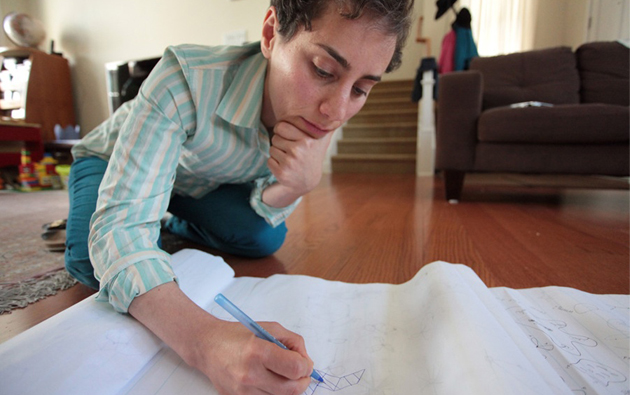
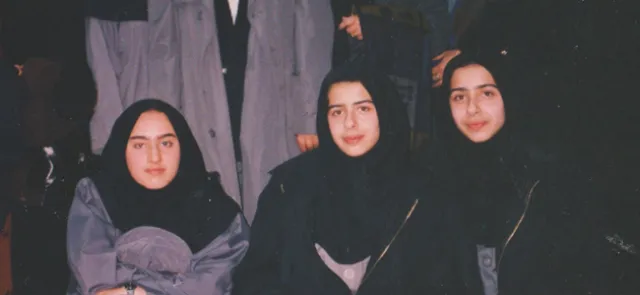
Her journey had taken her from the International Mathematical Olympiads (1994 and 1995) to Sharif University of Technology in Tehran, renowned for its highly selective admissions: each year, only 800 of the 500,000 students completing secondary school are admitted! It was there that she flourished, notably saying: "The more time I spent doing mathematics, the more addicted I became." Maryam was then recruited by Harvard University, where she defended her thesis under the supervision of Curtis McMullen (a 1998 Fields Medalist). She was appointed professor at Stanford at the age of 31 before, like her mentor, receiving the Fields Medal in August 2014 "for her outstanding contributions to the dynamics and geometry of Riemann surfaces and their moduli spaces". To date, she remains the only woman to have received the highest honor in mathematics.
A shock wave across Iran
------------------------
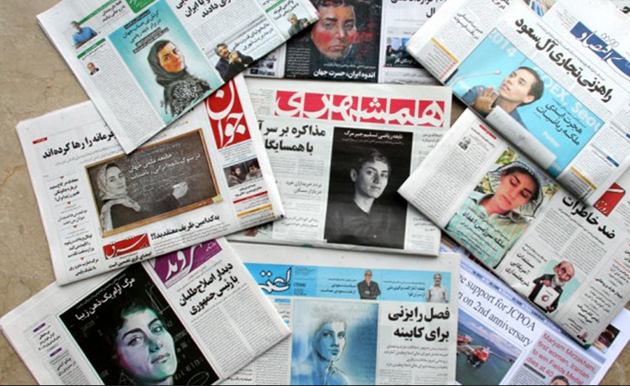
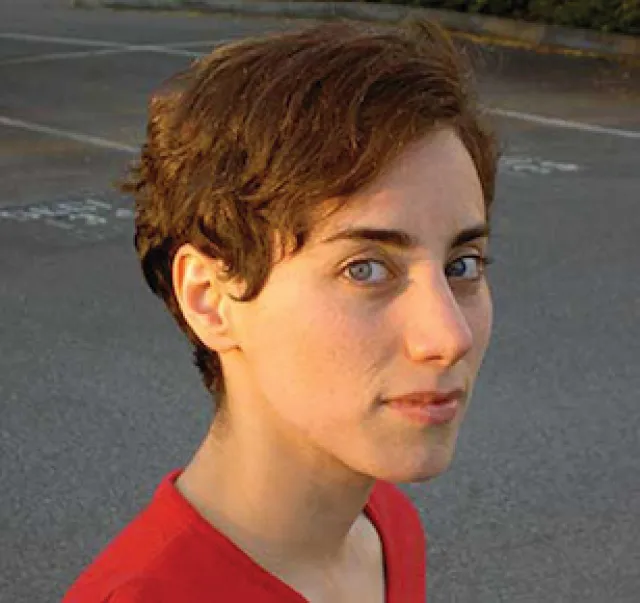
The announcement of Maryam Mirzakhani's death made front-page news throughout the Iranian press. Some newspapers did not hesitate to publish a photograph of her without an Islamic headscarf, thereby defying the law requiring every woman to cover her head in public. Iran's president, Hassan Rouhani, shared the sad news on his official Instagram account. Rouhani, himself a cleric, also posted a bareheaded photograph of the mathematician. In doing so, he praised her "symbolic role in gaining worldwide recognition for the talents of Iranian women and young people". The city of Tehran is also reportedly considering renaming one of the capital's streets in her honor.
This liberating power of mathematics in the face of religious constraints is nothing new in Iran. We know how deeply the country continues to honor the mathematician Omar Khayyam, whose libertine sonnets are tinged with skepticism.
The study of hyperbolic surfaces
----------------------------------
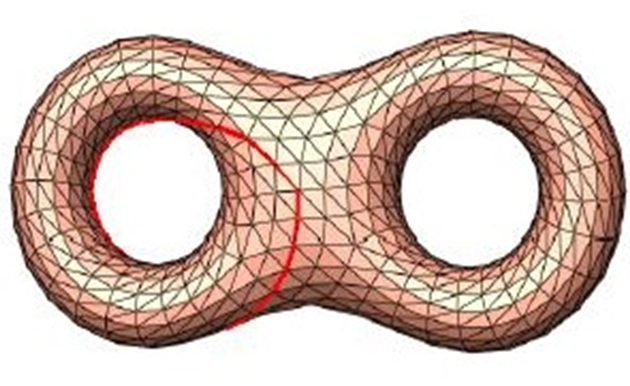
One of the strokes of genius of the German mathematician Bernhard Riemann (1826–1866) was to study curves… over the complex numbers, observing that they can be viewed as real surfaces. A Riemann surface is therefore a complex algebraic curve regarded as a two-dimensional real surface. Riemann's idea was to study these surfaces not as isolated objects, but as members of families that can be deformed into one another. He introduced the notion of genus, beginning with the sphere and its deformations, which have genus 0; then the torus, which has genus 1; and finally genus g, obtained by adding g "handles" to a sphere. All Riemann surfaces of genus g make up the moduli space of genus-g curves.
Maryam Mirzakhani summed up her own research as follows: "Most of the problems I work on concern geometric structures and their deformations. I am particularly interested in hyperbolic surfaces. Some properties of hyperbolic surfaces can be better understood by studying the moduli space parametrizing all parabolic structures on a given topological surface." It just goes to show that generalizing a problem can sometimes make it considerably simpler.