Tangente: Was making a documentary about Maryam Mirzakhani an obvious choice for you?
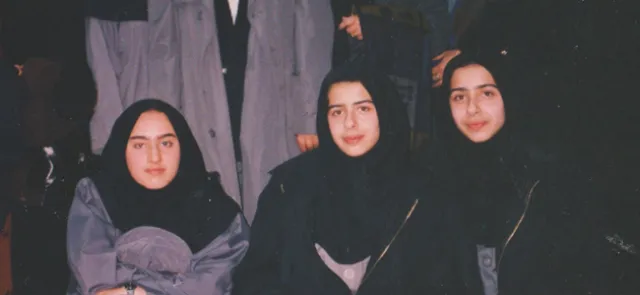
George Csicsery: I discussed the absolute necessity of a film about Mirzakhani with a few people as soon as I learned that she was the first woman to receive the Fields Medal, and the first Iranian. It was a major event. Since Mirzakhani was a very discreet and private person, there was not much enthusiasm about it. There was really no reaction. When she died, everything changed. David Eisenbud, who was then director of the Mathematical Sciences Research Institute (MSRI, now the Simons Laufer Mathematical Sciences Institute, SLMath), suggested to me that, if I thought it possible to make a documentary about Mirzakhani, he could find funding. That set everything in motion toward the end of 2017. We started filming in May 2018.
Mirzakhani is known for her deep and abstract work in geometry and dynamics. How did you approach the challenge of making her mathematics accessible to a general audience?
This is the most difficult mathematics I have ever encountered. You can imagine that, for a layperson, it was quite discouraging. The first filming took place during a two-day conference at Stanford where we filmed about nine lectures. I did not understand a single word.
As we began interviewing mathematicians who had worked with Mirzakhani, the outlines of what she was searching for started to take shape for me. I asked every mathematician in the film to explain the same concept over and over, until there was something I could grasp and possibly use directly in the film. Eventually, with the invaluable help of Jayadev Athreya and our narrator Erica Klarreich, we were able to develop descriptions that our animation artist Andrea Hale could turn into images. That is what we see in the film. I hope some aspects of these sequences stay in the viewer's mind, so that at least a glimpse of Mirzakhani's interests and achievements comes through.