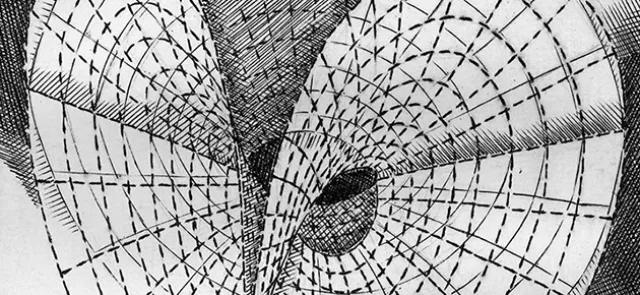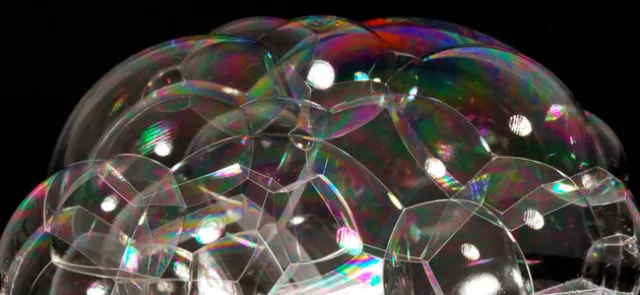
Every child knows that enclosing a volume of pressurized air inside a soap film creates a perfectly spherical surface: a bubble. The game is just as much fun without a pressure constraint: pull apart two rings previously dipped in soapy water, and a soap film forms between them, resembling a slim-waisted cylinder that mathematicians call a catenoid.
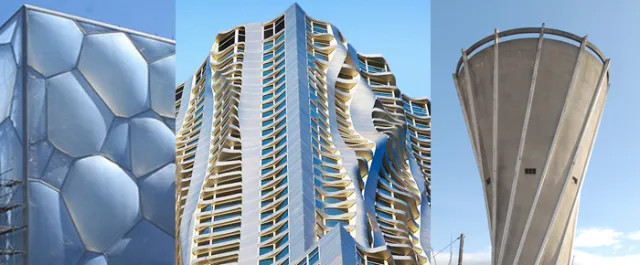
Because it is so fragile, a soap film subject to a pressure or boundary constraint can only adopt the shape that minimizes surface tension. This physicochemical property of soap can be modeled mathematically by a purely geometric property: soap films form surfaces whose mean curvature is constant, and an entire branch of geometry is devoted to them. Beyond soap bubbles, the in-depth study of these objects has led over the years to the development of new tools; it also offers fresh perspectives on other scientific fields. They appear, for example, in theoretical physics, where they model the horizons of certain black holes.
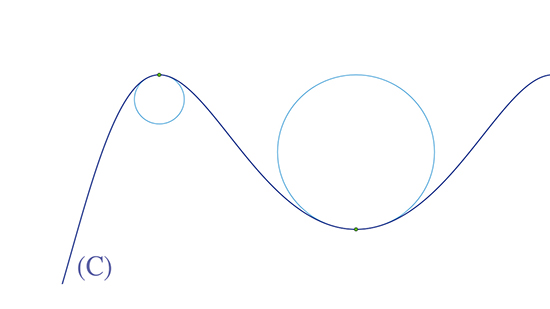
Osculating circles and curvature
-----------------------------