To find the shortest path between two points in a plane, all we need is a ruler to draw the line joining them. The problem is no more complicated for developable surfaces, such as cylinders, cones and the Möbius strip, which can be laid flat without tearing or stretching, and hence without altering distances. To find the shortest path, simply "flatten" the surface and draw a line with a ruler.
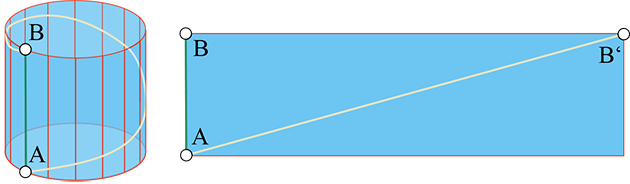
*Flattening a cylinder to determine its geodesics. This yields circles (the directrices, in orange), helices (in yellow) and straight lines (the generators, in red).*
On a cylinder, each point may be represented several times, yielding several possible curves a priori. They are all called geodesics, even though only one gives the shortest path, because they share a common property. They are the possible shapes of an elastic band stretched taut between the two points, provided the surface is frictionless and gravity is disregarded. Mathematically, geodesics are characterized by a differential condition which, when the curve lies in a plane, is equivalent to requiring the plane of the curve to be perpendicular to the tangent plane of the surface at every point (see box).
-