




The line
This issue is not fully translated into English yet; only translated content is shown.
Read the French versionAll folders in this issue
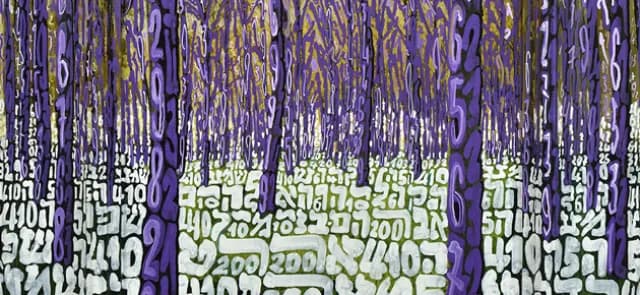
The line and real numbers
Representing real numbers as the points of a line is an idea that revolutionized geometry as much as analysis. Descartes, by locating the points of the plane with two numbers, played a major role in this. Since his contribution, we know how to express a line as an equation! The construction of real numbers in the 19th century is the culmination of the transition from an intuitive vision of the line to an axiomatic representation. This approach made it possible to study the notion of « proximity » of points, to define an interval and more generally to look at the topology of the real line.
The geometric line
Since Euclid, the line has been the foundation of geometry. Most figures contain them and many theorems have taken up the challenge of proving that certain points are collinear; from this we deduce the existence of remarkable lines, such as those of Euler or Simson (see opposite). Lines seem to "guide" curves and surfaces. A curve is locally assimilated to its tangent, at infinity to its asymptote. It can be defined by a family of lines that all prove to be tangent to it: this is the envelope. Finding lines in a surface leads to better constructing it. Remarkably, some surfaces are even a union of lines while everything seems curved within them!

New horizons
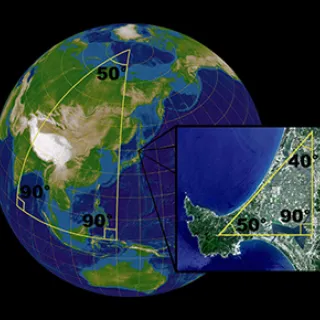
Non-Euclidean geometry, projective geometry: each new vision extends the concept of line. The notion of 'the shortest path from one point to another' gives a glimpse of the notion of geodesic on a surface, with surprises and fun problems. And computers get involved to help us construct lines!
All articles in this issue
The definition of the straight line through the ages
You thought you knew what a straight line is? Read on, and you may well start to doubt it…

A bit of semantics
A good droite is not necessarily mathematical: you find it in politics just as in boxing…
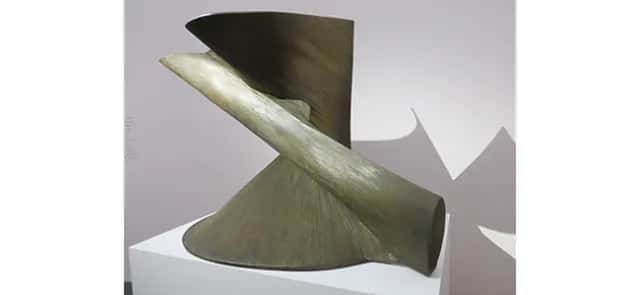
Antoine Pevsner: homage to the straight line
In 1956, the sculptor Antoine Pevsner declared: "The most important feature of my work today […], the principle on which all my sculpture is now built, is the exclusive use of straight lines."

Straight lines and optical illusions
For a mathematician, a line is a point in motion. For an artist, however, it is what defines the outlines of things. Without lines, there could be no shapes…