
Cevians and transversals
-------------------------
A cevian (in other words, a "Ceva line") is a line that passes through one of the vertices of a triangle. Its name is of course linked to that of the Italian mathematician Giovanni Ceva, who in 1678 proved the theorem that bears his name.
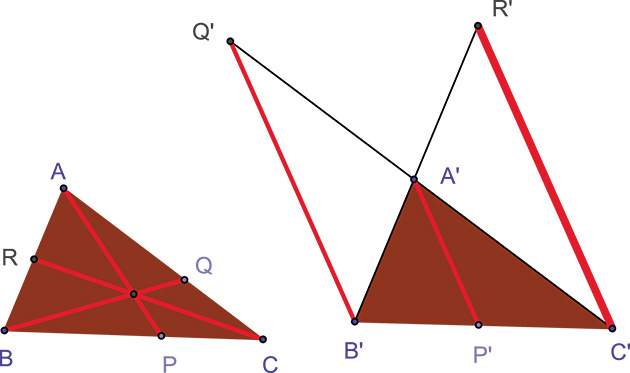
In a triangle ABC, for three points P, Q, R distinct from the vertices A, B and C, lying respectively on the lines (BC), (CA) and (AB), the cevians (AP), (BQ) and (CR) are concurrent or parallel if and only if,