The theorems of Menelaus and Ceva
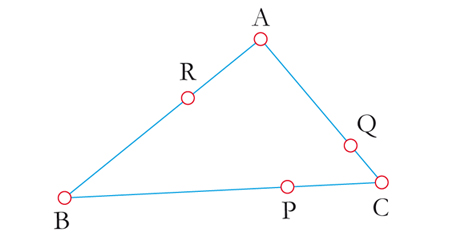
Menelaus's and Ceva's theorems, two classics of plane geometry, are similar in form. This resemblance becomes clearer when the notion of cross-ratio is introduced.


Menelaus's and Ceva's theorems, two classics of plane geometry, are similar in form. This resemblance becomes clearer when the notion of cross-ratio is introduced.


Articles recommended for you.

In France, Thales' theorem concerns parallel lines and proportionality. Its proof, combining algebra and plane geometry, is remarkably elegant. It also leads naturally to two landmark results in triangle geometry: Menelaus' and Ceva's theorems.

On his appointment as a professor at the University of Erlangen in 1872, Felix Klein, then only 23, presented a research program in geometry that has since become known as the "Erlangen Program." The concept of a group lies at its heart.

Points and lines in the plane are dual notions: theorems about collinear points correspond to theorems about concurrent lines. This duality can be defined geometrically. It even extends to space, through coplanarity.

The idea of pairing two mathematical objects according to a set of rules allows us to extend certain results without reinventing everything: that is the whole point of duality. Or, mathematically speaking, how to kill two birds with one stone.
Discussion
Sign in to post a comment and talk with other readers.
No comments yet. Be the first to respond.