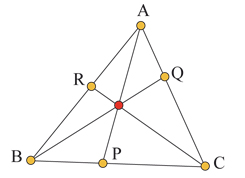
In geometry, duality can transform a theorem about collinear points into one about concurrent lines. We can simply use a duality principle to predict one theorem from another, before proving it independently. Thus, Menelaus's theorem can be used to predict Ceva's theorem.
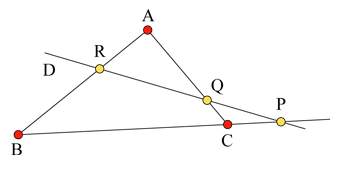
Menelaus's theorem states that if ABC is a triangle and D is a line intersecting its three sides at P, Q, and R, then the product is equal to 1.
Conversely, such a relation between the signed lengths of the line segments implies that P, Q, and R are collinear.