Vector spaces
All folders in this issue

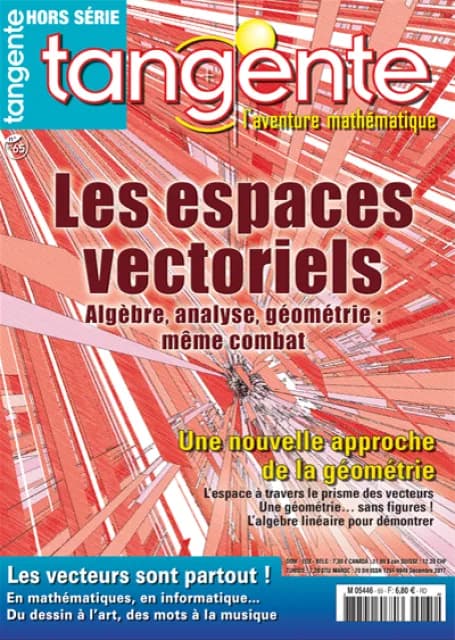
Vector spaces, history and axiomatics
The concept of vector space gradually emerged throughout the 19th century, in order to formalize the space that surrounds us. Visionary pioneers enabled this shift in perspective by introducing the right concepts of « basis », of « dimension », of « determinant », of « linear map »… Linear algebra became the framework for studying numerous theories, particularly in analysis. Today, with the development of computer tools, linear algebra is more easily implemented through matrix computation.


Geometry in a New Way
Can we treat geometry as a branch of algebra? This is the purpose of using vector spaces. The results are spectacular: "algebraizing" geometry makes it possible to revisit the oldest of sciences, to generalize it to unexpected or more abstract contexts, to gain rigor, to adopt a more systematic and computational approach, to rethink the notion of space, and to discover new results! This new "mathematics without figures" preserves geometric intuition, but goes well beyond... By extending the notion of distance introduced by Euclidean spaces, the introduction of normed vector spaces, which makes it possible to broaden the field of vector spaces to functional analysis, leads to a new harvest of results and applications.



Many applications
What do vectors and vector spaces bring us beyond a presence, like all mathematical structures, a little everywhere around us? An opening and an enrichment of our approach to many fields, illustrated by some striking examples, where this change has operated a real revolution, accentuated by the advent of powerful calculation tools! Vector drawing in graphics, the enormous amounts of texts or corpora in literature… And Yannis Xenakis in person even opened the way to interesting vector techniques in musical composition…