



Geometry in a New Way
Can we treat geometry as a branch of algebra? This is the purpose of using vector spaces. The results are spectacular: "algebraizing" geometry makes it possible to revisit the oldest of sciences, to generalize it to unexpected or more abstract contexts, to gain rigor, to adopt a more systematic and computational approach, to rethink the notion of space, and to discover new results! This new "mathematics without figures" preserves geometric intuition, but goes well beyond... By extending the notion of distance introduced by Euclidean spaces, the introduction of normed vector spaces, which makes it possible to broaden the field of vector spaces to functional analysis, leads to a new harvest of results and applications.
All articles in this folder

From vector spaces to affine spaces… and back again!
Linear algebra arose from the need to provide a framework for ordinary geometry. From a computational standpoint, it has been a success! By making certain operations and manipulations simpler and more systematic, it streamlines geometric reasoning and makes it more rigorous.
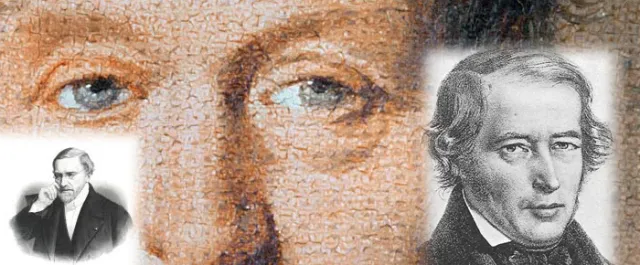
Geometry without figures
Michel Chasles dreamed of it; the theory of vector spaces now makes it possible: we can do geometry without drawing a single figure. Geometric and algebraic viewpoints thus coexist, and everyone can choose whichever feels most comfortable!

Collinearity, coplanarity, concurrency... it's all the same story!
Points and lines in the plane are dual notions: theorems about collinear points correspond to theorems about concurrent lines. This duality can be defined geometrically. It even extends to space, through coplanarity.

Composing geometric transformations
Some geometric problems, however complicated they may look, quickly become clear once geometric transformations are brought in, and are often solved by composing them. To do this, it helps to recast them in vector terms.

First examples of vector spaces (2)
Every good vector space E needs a base field K. But what exactly is a field?

Translations and rotations – Maths brief | Tangente
Translations and rotations have many applications—and not only in geometry!

The slow emergence of Euclidean spaces
The axiomatic definition of the dot product provided a rigorous and fruitful framework for studying metric properties—those involving distance, angle, and orthogonality. This concept did not emerge clearly until the 1920s.

Cross product and scalar triple product
Defined on three-dimensional Euclidean space, these two products grew out of Hamilton's quaternions. They have become useful tools in geometry and mechanics.