Solving a geometry problem, whether in the plane or in three-dimensional space, can sometimes prove tricky. It often helps to turn it into a vector problem and bring in suitably chosen transformations. These can then be composed… or decomposed, allowing vector algebra to make the conclusion easier to reach.
-
Transformations of points and vectors
-------------------------------------
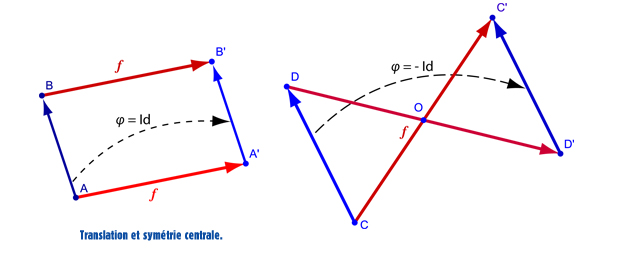
In the plane or in space, a transformation is first and foremost a bijection: it assigns each point of the plane (or of space) a unique point of the plane (or of space). Some geometric transformations are already familiar to us. Less familiar, however, are the associated vector transformations: we move from a space of points – which mathematicians call an affine space – to a vector space. Each transformation of a point space (in the plane or in space) gives rise to a vector transformation: if f is a transformation that sends every point A to A' and every point B to B', then the associated vector transformation is defined by and is easily shown to be linear, meaning that for every pair (a, b) of real numbers.