The cross-ratio, one of the pillars of projective geometry, can be expressed in real terms through the harmonic range or in complex terms, and lends itself both to straightforward constructions and to elegant proofs. Not only does it help solve geometric problems that might otherwise prove difficult, but it also opens the way to streamlined arguments.
-
Using the harmonic range to avoid calculations
----------------------------------------------
The "soft" version of this celebrated cross-ratio is the harmonic range. The adjective derives from the Greek word "armonia", with its musical connotations for Pythagoras. Suppose that a string fixed at its endpoints D and B—with D producing the note C—is plucked at its midpoint A: its vibration produces the C an octave higher. If it is now plucked at C, one-third of the way along [AB], it produces G: this is armonia. During the Renaissance, DC would be called the harmonic mean of DB and DA, expressed by the equality \frac\mathrm{AC}\mathrm{AD}=\frac\mathrm{BC}\mathrm{BD}, or, in the notation of the figure, that is,
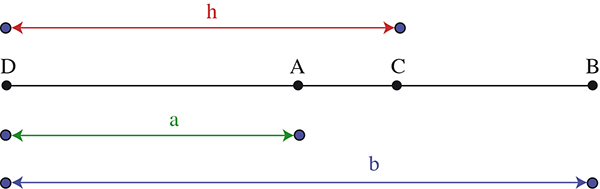
The harmony of a vibrating string.
The notion passed from music into geometry in the 17th century: the points A, B, C and D were said to form a harmonic range, terminology already found in the work of the mathematician and musician Philippe de La Hire (1640–1718).
Two centuries later, using directed lengths (see FOCUS), the four collinear points (A, B, C, D)—customarily taken with one of C and D inside the line segment [AB] and the other outside it—would be said to form a harmonic range; equivalently, C and D would be called harmonic conjugates with respect to A and B. This amounts to writing \frac{\overline\mathrm{CA}}{\overline\mathrm{CB}}=-\frac{\overline\mathrm{DA}}{\overline\mathrm{DB}}.
This notion from affine geometry delighted generations of high-school students, who encountered it in many of their problems and saw it give rise, when translated into algebra, to many formulas. In using the harmonic range, however, we shall focus less on pure calculation than on its geometric role as a gateway to projective geometry.
What happens if C is the midpoint of [AB]? There is then no "visible" point D satisfying the previous relation: D is said to be the point at infinity of the line (AB). The following short problem gives substance to this limiting case. In a trapezoid ABCD whose parallel sides are [AB] and [CD], the lines (AD) and (BC) meet at I, while the lines (BD) and (AC) meet at J. K is the midpoint of [AB], and L that of [CD]. There are many ways—using vector or analytic methods, barycentric coordinates, dilations or oblique reflections—to prove that I, J, K and L are collinear, but that is not the main point. What matters here is that (I, J, K, L) forms a harmonic range, since the two ratios in \frac{\overline\mathrm{IK}}{\overline\mathrm{IL}}= - \frac{\overline\mathrm{JK}}{\overline\mathrm{JL}}, are both equal, by Thales' theorem, to \frac{\overline\mathrm{KB}}{\overline\mathrm{LD}}.
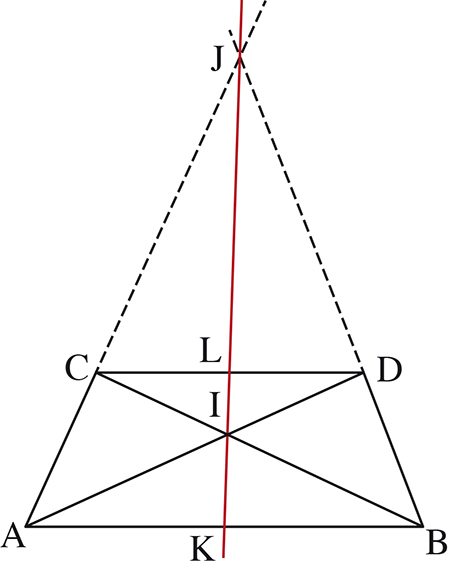
What happens if the trapezoid becomes a rectangle, with (AC) parallel to (BD)? This is the limiting case described above: I becomes the midpoint of [KL], while J is the point at infinity in the direction of (AC) and (BD).
Pencils of lines
------------------------
Even more fruitful than the harmonic range is the notion of a harmonic pencil of lines (see the article "An invariant under central projection"). This consists of four concurrent or parallel lines, each passing through one of the points of a harmonic range. Using dilations, one can prove that the intersections (A, B, C, D) of these four lines with any transversal themselves form a harmonic range. Another interesting property is that, when the lines meet at O, the line through B parallel to (OA) meets (OC) and (OD) at two points whose midpoint is B. This property is used to construct a harmonic pencil. It also shows that two intersecting lines together with the angle bisectors of the angles they form constitute a harmonic pencil.
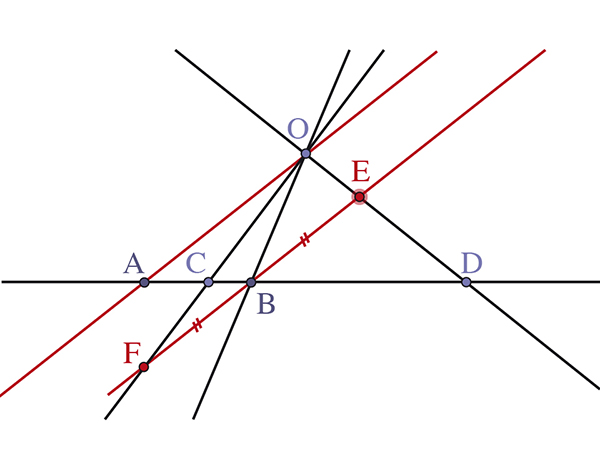
We can go further: the very existence of this harmonic pencil proves that the points where the internal [AD) and external [AE) angle bisectors from vertex A of triangle ABC meet the opposite side divide it into segments proportional to [AB] and [AC]. A powerful tool, isn't it?

The fact that [AD) and [AE) are angle bisectors is equivalent to DB / DC = EB / EC = AB / AC.
If (BG) is parallel to (AE), this necessary and sufficient condition follows by combining the fact that the four lines (AE), (AB), (AD) and (AC) form a harmonic pencil,
the fact that triangle ABG is isosceles, and Thales' theorem.
-
Generalizing to the cross-ratio
------------------------------
With the harmonic range, we encountered two ratios; taking their quotient gives the cross-ratio. It already appeared implicitly in the work of ancient geometers such as Pappus and Apollonius, and the French mathematician Michel Chasles (1793–1880) called it the anharmonic ratio. Thus, given four collinear points A, B, C and D, the cross-ratio of (A, B) and (C, D) is \frac{\overline\mathrm{CA}}{\overline\mathrm{CB}}:\frac{\overline\mathrm{DA}}{\overline\mathrm{DB}}. When (A, B, C, D) forms a harmonic range, it equals −1.
This notion of cross-ratio, which lies at the heart of projective geometry, has many facets.
The cross-ratio of four real or complex numbers, denoted (a, b, c, d) or sometimes [a, b, c, d], is the quantity
The cross-ratio Δ of four concurrent or parallel lines is defined as follows: if a transversal meets these lines at A, B, C and D, then Δ is the cross-ratio of the four points of intersection. It can be proved that this value is independent of the chosen transversal (see the proof in the box "The Möbius formula").
Given a point O, the cross-ratio of four points A, B, C and D on the same circle is defined as that of the four lines (OA), (OB), (OC) and (OD).
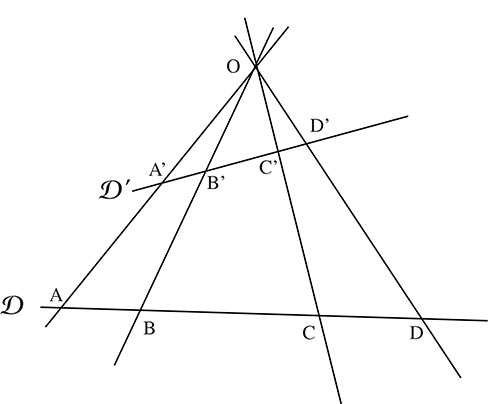
Among the cross-ratio's many properties, one is fundamental: four points in the complex plane are cocyclic or collinear if their cross-ratio is real. Geometry has drawn a wealth of beautiful applications from this property! It can be remarkably effective in proving certain results.
A fine example is one of the problems set at the 2019 Russian Geometry Olympiad honoring Igor Sharygin (1937–2004):
The quadrilaterals ABCD and A1B1C1D1 are centrally symmetric about a point P. We also know that A1BCD, AB1CD and ABC1D are cyclic (that is, their vertices are cocyclic, or lie on the same circle). Prove that ABCD1 is cyclic as well.
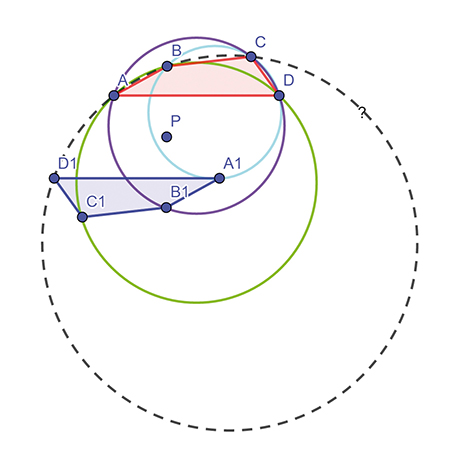
We could, of course, tackle this with a huge "angle chase"… but only if we can ferret out the "right" inscribed angles! Alternatively, the cross-ratio gives a very quick solution requiring only a few calculations…
Choose P as the origin (with complex coordinate 0), and let a, b, c and d be the respective complex coordinates of A, B, C and D. The complex coordinates of A1, B1, C1 and D1 are then, in order, −a, −b, −c and −d. We can now express each cocyclicity condition in turn:
• for A1, B, C and D: the cross-ratio is real;
• for A, B1, C and D: the cross-ratio is also real;
• for A, B, C1 and D: the cross-ratio is real as well.
It follows that the product of p and q, divided by r, is always real. Indeed:
and therefore
or, equivalently,
This relation says exactly that A, B, C and D1 are cocyclic. Neat, isn't it?