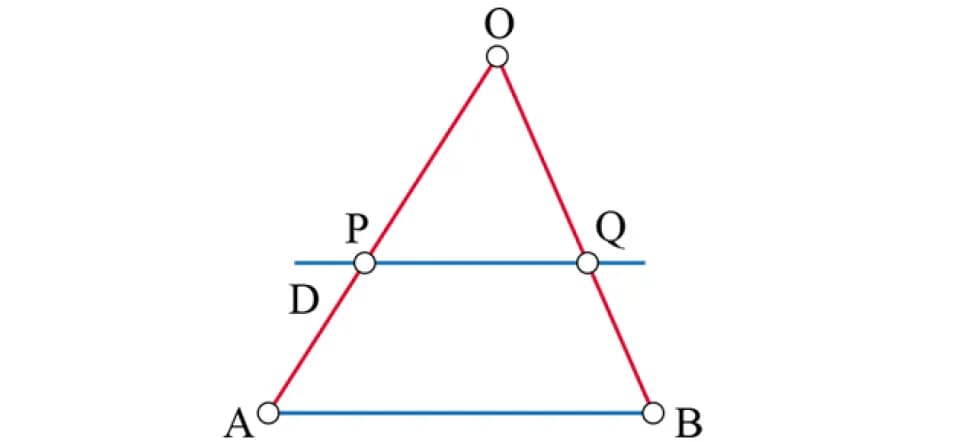
In its classical form, Thales' theorem is a result in plane geometry. Let OAB be a triangle and D a line parallel to the side [AB]. The line D intersects the two sides [OA] and [OB] at points P and Q.
Thales' theorem then gives the following numerical relation:
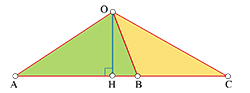
The simplest proof of this equality uses the areas of certain triangles. It relies on a lemma concerning two triangles, OAB and OBC, constructed on the same line (ABC). They have the same altitude (OH).