A forgotten tool
----------------
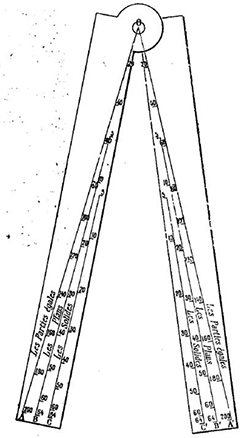
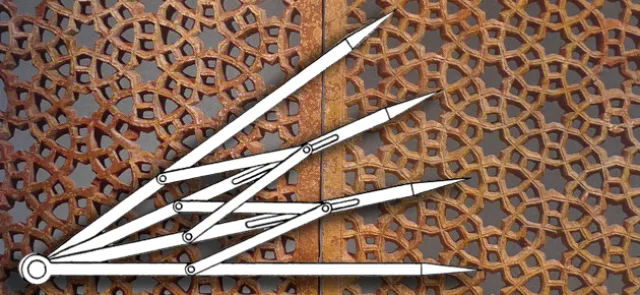
In a technological world where even the smallest distance can be determined with extreme precision and almost instantaneously, it is hard to imagine that there was a time when constructions and reasoning about lengths were preferred to actually measuring them. These are the questions addressed by the theory of proportions, in which Thales' theorem finds its place. Among the instruments that draw on this theorem in their design or use — such as the geometric square or Jacob's staff (see Mathématiques et Géographie, Bibliothèque Tangente 40, pages 79 and 81) — is the proportional compass. Generally attributed to Guidobaldo del Monte, it appeared toward the end of the 16th century. It was later refined by Galileo, who devoted a book to it.
-
Dividing a length
------------------