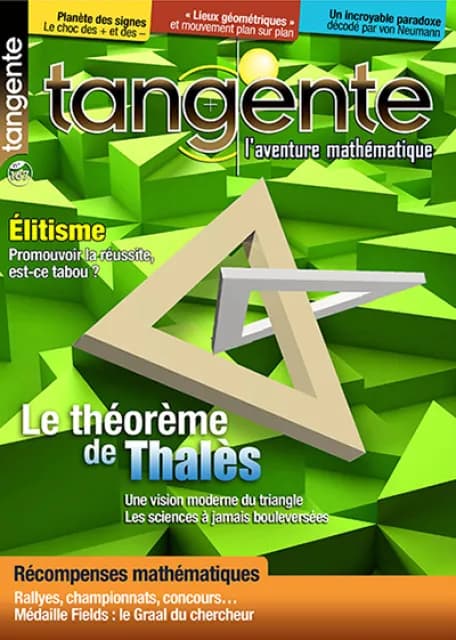
Thales' theorem
This issue is not fully translated into English yet; only translated content is shown.
Read the French versionAll folders in this issue

Contests and rewards around math
Rewards stimulate, this is also true for math, and this has been the case for centuries. Still, the authorities need to support these initiatives more, which they are unaware of and sometimes consider elitist… In the 1900s, the French national competition was created in France. Visionary and motivated teachers then developed other types of experiences: less school-like competitions, tests reserved for girls, tournaments with several rounds, group rallies… whose success seems undiminished among young people. Others, older, may receive other rewards: for popularization actions, for multidisciplinary creations, or even, if their research work is universally recognized, the famous Fields Medal!


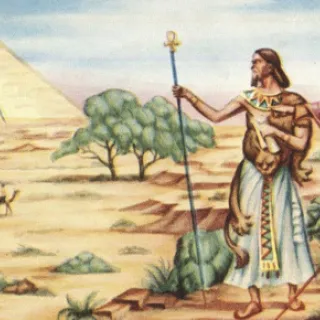
The saga of the great theorems, Thales' theorem
The saga of the great mathematical theorems is launched! To whom honor is due, honor: the king of triangle geometry, Thales' theorem, opens the ball. His name will forever remain attached to a famous scholar living in Greece in the 6th century BCE. And its content will forever revolutionize mathematics, but also other sciences like optics or astronomy. But how can we be certain that Thales is the father of this so important result? Often, indeed, a theorem is named more as a tribute to a mathematician than after the name of its discoverer (not always identified)*… The question is ultimately of little importance compared to the magnificent gems and beautiful stories evoked by the name of the theorem. (* Read the article Tell me, theorem, what is your name?)

All articles in this issue
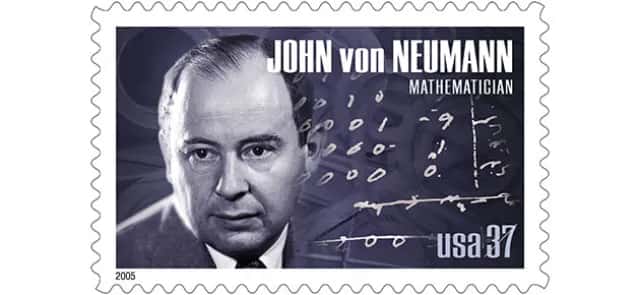
John von Neumann: means and excess
The Banach–Tarski paradox claims that, in theory, the pieces of a single loaf can be turned into two loaves. It fell to the protean genius John von Neumann to explain the underlying reason for this mathematical miracle. The notion of amenability that he introduced then spread widely.

Fashion by algorithm
Who are these devils dressed in Prada in New York? It's not a joke — it's the title of a scientific paper by researchers from the eminently respectable National Taiwan University and University of Rochester (United States).
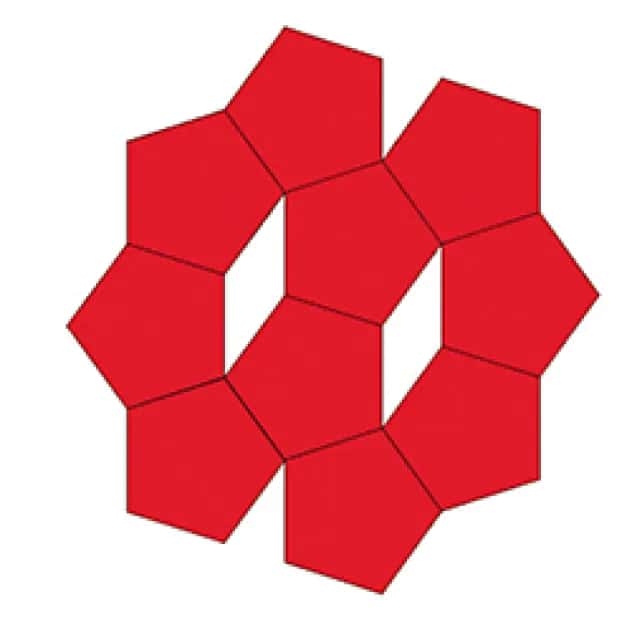
The adventurers of the forgotten pentagon
The recent discovery of a pentagon that tiles the plane brings to mind an endearing figure: Marjorie Rice. An American homemaker, she would hide away in her kitchen to indulge her passion for mathematics.

Dynamic geometry: rediscovering plane motion!
Plane motion provides a valuable framework for using kinematics to study the geometric properties of figures. In particular, it offers an efficient and insightful way to determine loci. In the past, it was studied in connection with the connecting-rod and crank mechanisms of locomotives.

Did you say "Extraordinary"?
When film puts mathematics in the spotlight, it is often to link it with autism, as in the recent film Le Monde de Nathan (see Tangente 165). When television puts it in the spotlight, it is to showcase feats.

Music, serenity, and fractal art
The artist Alan Stivell, a musician, lyricist, composer and performer well known to defenders of Breton culture, chose a fractal image to illustrate his twenty-fourth album, AMzer (World Village, 2015).

Arithmetic on stage
Reality, by Daria Deflorian and Antonio Tagliarini, was performed this past autumn at the Théâtre de la Colline in Paris (20th arrondissement), and what interests us here is not so much the play's characters as the relationship between its heroine, Janina Turek, and numbers.

The subverted geometry of Julien Prévieux
The exhibition by Julien Prévieux, winner of the 2014 Marcel Duchamp Prize, "Des corps schématiques", running until 1 February 2016 at the Centre Pompidou (Paris), is not, strictly speaking, mathematical art, but since its theme is the recording of movement, some of the artist's geometric obsessions inevitably appear.

The Simpsons: a website and books
Countless series have taken an interest in science over the past dozen years or so. Mostly crime dramas, they draw on elements from biology, and sometimes from mathematics, as with Numb3rs.

Beware of statistics
A news brief in Challenges 429 (April 2015) reports that "48% of American women aged 15 to 44 have no children."