



The saga of the great theorems, Thales' theorem
The saga of the great mathematical theorems is launched! To whom honor is due, honor: the king of triangle geometry, Thales' theorem, opens the ball. His name will forever remain attached to a famous scholar living in Greece in the 6th century BCE. And its content will forever revolutionize mathematics, but also other sciences like optics or astronomy. But how can we be certain that Thales is the father of this so important result? Often, indeed, a theorem is named more as a tribute to a mathematician than after the name of its discoverer (not always identified)*… The question is ultimately of little importance compared to the magnificent gems and beautiful stories evoked by the name of the theorem. (* Read the article Tell me, theorem, what is your name?)
All articles in this folder
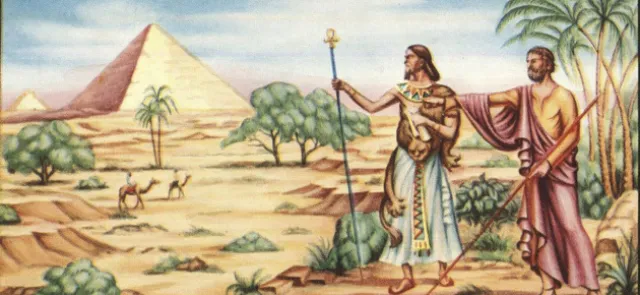
Thales and his theorem: historical uncertainty explained | Tangente
Who has never heard of Thales's theorem? Yet this extremely famous geometric statement is also one of the theorems whose history is least certain. Let's try to separate history from legend...

Tales of Thales
Thales fascinates! Many historians of science and mathematics have taken an interest in this legendary figure.

The king of geometry: Thales' theorem
In France, Thales' theorem concerns parallel lines and proportionality. Its proof, combining algebra and plane geometry, is remarkably elegant. It also leads naturally to two landmark results in triangle geometry: Menelaus' and Ceva's theorems.

The proportional compass
Two thin, hinged plates for calculating proportions.