An ingenious mechanical device, inspired by the famous "gardener's method," can cut an elliptical shape from a wooden board with given axis lengths. To draw an ellipse, the gardener's method uses an inelastic cord and a pencil that is moved around while keeping the cord taut at all times.
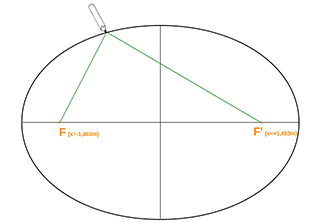
*An ellipse E is, by definition, the set of points M for which the sum of the distances to two fixed points (F and F') is constant. Its equation can be written as x2 / a2 + y2 / b2 = 1, where a is the length of the semimajor axis and b that of the semiminor axis.*
The following animation is available on YouTube:
Thanks to Grégoire Baudry for his comments on an ellipse-cutting device based on a construction derived from this method (see the figure below). Two points on a rod are constrained to move along two perpendicular axes, while another point on the rod traces the intended ellipse. As the rod moves, all its points trace ellipses centered at O, the intersection of the two axes.
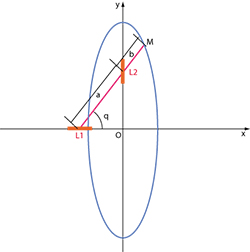
As the device moves along the axes (Ox) and (Oy), the sliding of tabs L1 and L2 keeps the lengths a and b constant. The x-coordinate x(M) of point M is b cos(θ), while its y-coordinate y(M) is (a + b) sin(θ). After a rotation through 90°, this is the equation of an ellipse with major axis a + b and minor axis b. This figure calls to mind the motion of a strip of paper sliding across a plane—and a long-forgotten chapter of geometry: plane motion. This type of motion involves a fixed plane, P, and a moving plane, M.
We assume that the motion is parametrized by time t. During the motion, points such as A and B trace the curves *CA and CB, respectively. Since distances are preserved, the plane moves from position M(t) to an infinitesimally close position M(t') (where t'=t+dt) by an infinitesimal rotation through angle dθ about a point I(t), called the instantaneous center of rotation*.
####
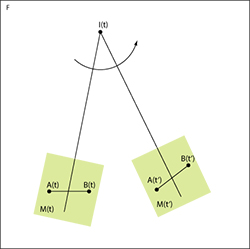
During the motion of the moving plane M(t), the distance between any two of its points A and B remains constant, indicating that at each instant the displacement is a rotation.
During the infinitesimal motion of point A along the curve *CA, the normals at two neighboring points A and A' intersect at the instantaneous center of rotation, regardless of which point is considered. Thus, at any given time t, the normals to all the curves traced by the various points of the plane M* intersect at the instantaneous center of rotation. This provides an easy construction of that point, due to Chasles.
####
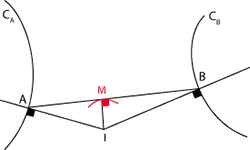
A line (AB), with point A moving along CA and point B along CB, envelopes a curve. The instantaneous center of rotation I lies at the intersection of the normals to CA and CB at A and B. The point where the line (AB) touches its envelope lies on the perpendicular from I to (AB).
-
Fixed centrode, moving centrode and envelope
---------------------------
The locus of the instantaneous center of rotation in the fixed plane P is called the fixed centrode B; its locus in the moving plane M is the moving centrode R. The moving centrode R "rolls without slipping" on the fixed centrode B. This can be visualized by imagining the two centrodes as tiny toothed curves that mesh as the motion unfolds.
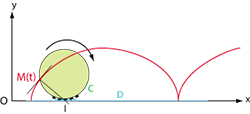
A point M on a circle C rolling without slipping along a line D generates a cycloid. The normal to the cycloid at M passes through the instantaneous center of rotation I of the plane motion.
Here is an animated example available on YouTube:
Thus, when a circle C (the moving centrode) rolls without slipping along a line D (the fixed centrode), the path of a point M on the circle C in the plane P is a cycloid. Descartes derived many properties of this curve in the 17th century, using properties of this motion in a letter to Father Mersenne. Descartes may be regarded as the founder of this field of geometry. Other mathematicians extended the field, notably Michel Chasles (1793–1880; see Tangente 160) and Gabriel Koenigs (1858–1931). Koenigs proved that if three planes move relative to one another, then the three instantaneous centers of rotation of the planes taken in pairs are collinear.
Plane-on-plane motion is used in the theory of envelopes of lines (the envelope of a family of lines is the curve to which all the lines are tangent). The so-called characteristic point at which a line touches its envelope can therefore be found simply by using Chasles's construction of the instantaneous center of rotation from the normals.
Return to our strip of paper, on which two points A and B, separated by a distance l, move along two perpendicular axes (see Figure I).
At time t, the instantaneous center of rotation I(t) lies on the line through B perpendicular to (Ox) and on the line through A perpendicular to (Oy). The quadrilateral OAIB is a rectangle whose diagonals have the fixed length l: the locus of the instantaneous center of rotation I in the fixed plane F is the circle *CF with center O and radius l. This circle CF* is the fixed centrode.
The circle R(t) with diameter l and center P(t), where the diagonals of the rectangle OAIB intersect, is tangent at I to the circle *CF. In the moving plane M of the strip of paper, this circle is the locus of the instantaneous center of rotation I(t). It is the moving centrode: the circle R(t) rolls without slipping along the circle CF. The locus of the point P (t) in the fixed plane is the circle with center I and radius l/*2 (Figure II).
####
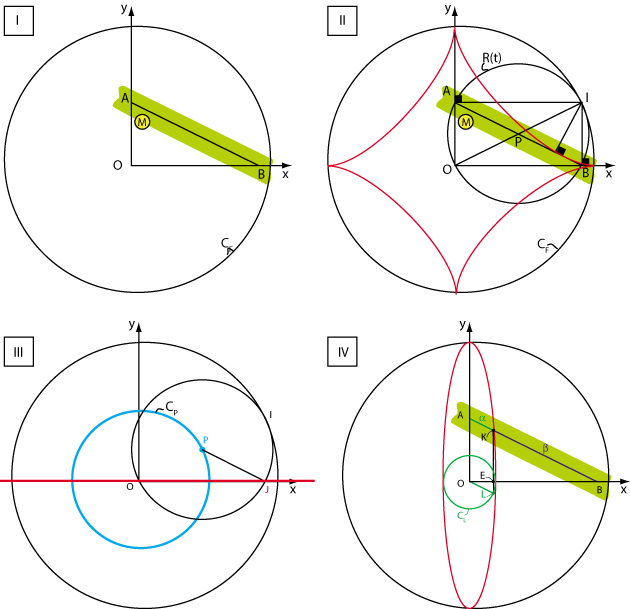
Different aspects of the kinematics of the strip of paper. (I) Initial configuration: as the moving plane attached to the strip moves, point A travels along (Oy) and point B along (Ox). (II) The envelope of the line (AB) is an astroid. (III) As the strip moves, point K, the midpoint of [AB], travels along a circle, while point J travels along the x-axis: this configuration is known as La Hire's fly. (IV) A geometric proof that a point K on the line (AB) travels along an ellipse.
Point J in Figure III, where the circle R(t) intersects the axis (Ox), moves along the axis (Ox), while K moves along the circle *CK. KJ = l / 2. This gear mechanism is known as La Hire's fly*, named after the French astronomer and mathematician Philippe de La Hire (1640–1718). This mechanism transforms the circular motion of point K into the straight-line motion of point J (an animation is available online). In the past, it was extensively studied in connection with the connecting-rod and crank mechanisms of locomotives.
Let us give another geometric proof that the locus of point K on the line segment [AB] of the strip of paper in Figure IV is an ellipse. Let AK=α and KB=β. Complete the parallelogram OAKL by adding point L. During the motion, point L moves along the circle *CL with center O and radius α. By Thales's theorem, KE / KL = KE / AO = KA / KB = α / β. Thus, point K is obtained from point L by an orthogonal affinity with axis (Ox) and ratio α / β. The locus of K is the ellipse obtained from the circle CL* by this affinity.
Geometry is almost entirely absent from the curriculum, and kinematics is missing altogether. That may be a pity: the subject offered an engaging dynamic view of geometric problems. Our education minister wants mathematics "that is meaningful and grounded in the real world". Doesn't plane motion offer a meaningful approach to geometry?