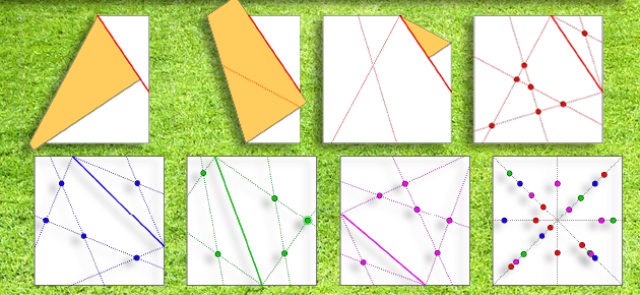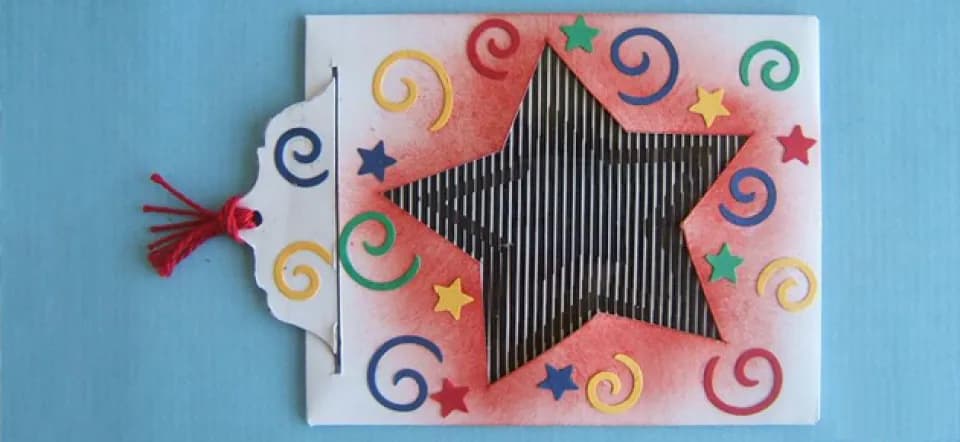
Origami and, more generally, techniques for folding a sheet of paper offer delightful excursions into geometry, topology and combinatorics (see our feature “La mathématique du pliage” in Tangente 146, 2012). What new possibilities arise if we expand the range of permitted operations—for example, by allowing the paper to be cut? Pop-up cards (or simply pop-ups) alone have much to teach us and suggest original, accessible avenues of research for anyone who appreciates beautiful geometry.
Helm sweet helm
Engineer Stephanie Jakus and mathematician Joseph O’Rourke studied one particular card. Before we begin, we need to distinguish between a valley fold and a mountain fold. With the former, the line of the fold can act as an (unstable) support for the sheet; it is represented schematically by a dashed line. With the latter, the fold forms a ridge; it is represented by alternating dashes and dots.
The valley fold and the mountain fold.
To make Jakus and O’Rourke’s card, first fold it into two panels with a valley fold. Draw a circle in the middle. Within the circle, cut narrow strips of paper perpendicular to the fold. When the card is opened (denote its opening angle by α), fold these strips outward with a mountain fold along the diameter—precisely where the valley fold lies—and the resulting shape resembles the visor of a helm. The pair then wondered what kind of curve was formed by the visor’s edge in the plane midway between the card’s two faces.