Geometry has its beauties and its surprises. Who would imagine that, whatever the shape of a road, the circumference of a wheel can be tailored so that its hub remains at a fixed height? Conversely, given a wheel, however sophisticated its shape, we can find a road that gives it this property. No cheating, of course: after one (or more) complete turns of the wheel, the road must return to the same configuration; in other words, it must be periodic.
Squaring the circle?
-------------------------
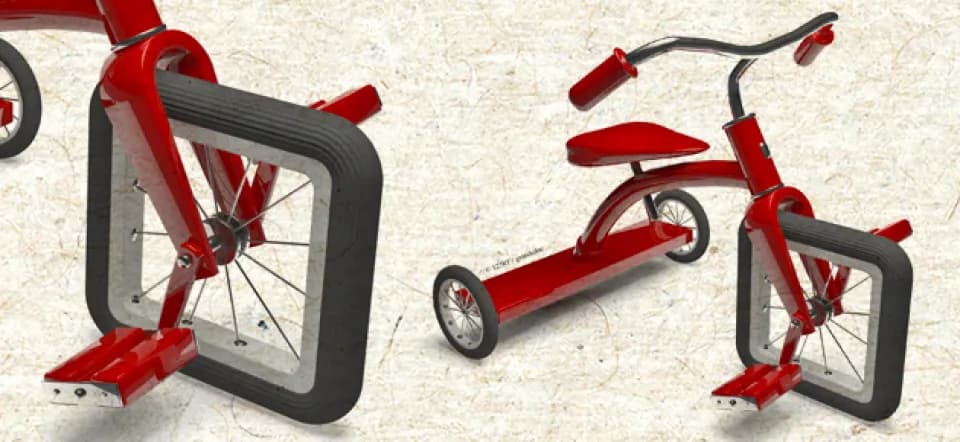
The simplest polygonal wheel is the square wheel. Since a square consists of four line segments, it is natural to examine the case of a line that "rolls" along a road. The road then takes the form of an inverted catenary—that is, the curve formed by a chain held at both ends (see the article "Parabolas and catenaries"). The equation of the catenary is y = (*e x + e* – *x *) / 2. The American-Canadian mathematician Stanley Wagon (born 1951), one of the geometers who helped solve this problem, built a working wheel-and-road pair.