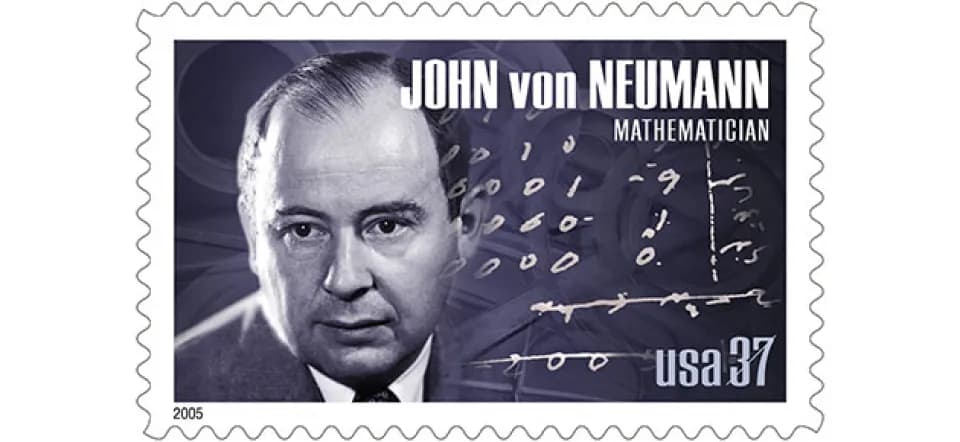
János Neumann (1903–1957), who would become John von Neumann when he was naturalized as a US citizen in 1937, is born in Budapest in 1903. His middle-school teacher, László Rátz, quickly recognizes his exceptional gifts, due in large part to an eidetic memory that allows him to retain forever every book he reads, and sends him to study with Michael Fekete ("black" in Hungarian), a student of the famous Lipot Fejér ("white" in Hungarian), who had himself studied under Hermann Schwarz using his German name, Weiss… Neumann publishes his first paper with Fekete at the age of 18—and wins the Eötvös Prize for it.
-
"I was afraid of him!"
---------------------------
At his father's insistence, motivated by financial considerations, he begins studying chemistry in Berlin, where he meets Albert Einstein, while occasionally attending Fejér's lectures with Edward Teller (father of the H-bomb). He earns his chemistry degree in 1925 and completes his thesis in mathematical logic in 1926. Around this time, George Pólya, a leading authority on the art of problem-solving, presents a difficult open problem at a conference. Five minutes later, János stands up, walks to the blackboard and gives a proof. Pólya declares: "From that day on, I was afraid of him!"
He then studies in Göttingen from 1926 to 1927 under David Hilbert, and there meets Robert Oppenheimer (father of the A-bomb). Given the turn events are taking in Europe, he settles in the United States in 1933, along with many of his compatriots (Teller, Szilárd, Wigner, von Kármán…). Einstein is said to have remarked that extraterrestrials not only exist but are at the IAS (Institute for Advanced Study in Princeton), that they speak a strange language understood only by themselves, and that they claim to come from a distant, unknown country called Hungary.