The word "dual" is used in many ways in mathematics: we speak of the dual of a vector space (see the article "L'échangisme en géométrie" ), of a polyhedron, of a graph, and even of a theorem. This notion of "dual theorems" is fundamental. Projective geometry provides an ideal setting in which to illustrate the importance of duality.
Although the objects described as "dual" differ, the same phenomenon is actually at work: starting with a set E of objects, if E can be put in bijection with another set E\, then E\ is called the dual of E. Thus, the dual of the dual of E is E itself. The precise meaning of the word can, however, take various forms depending on the context. A first, elementary example is the complement of a set: each element X of the set of subsets of a given set E is paired with its complement X’ in E. The set is its own dual under this operation.
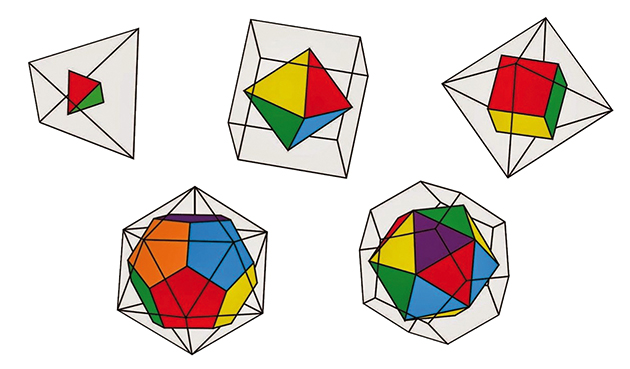
The dual of a tetrahedron is a tetrahedron; the dual of an octahedron is a cube (and conversely); and the dual of a dodecahedron is an icosahedron (and vice versa).
-