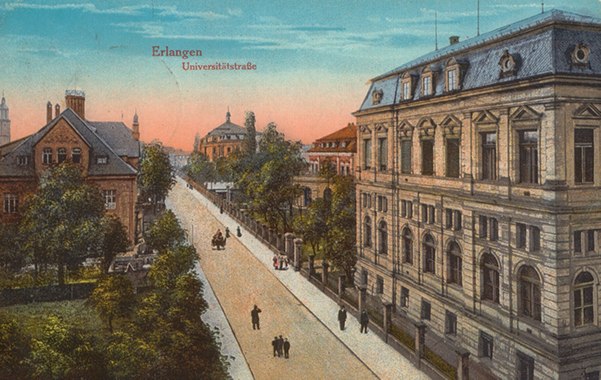
Felix Klein's revolutionary contribution in his Erlangen lecture was to reveal the fundamental role, at the heart of each type of geometry, of the group of transformations acting on its objects, and to use that group or some of its subgroups to identify invariants—properties of figures that remain unchanged under the transformations.
The converse is also true: geometric properties can be characterized by their invariance under certain groups of transformations.
Klein based his program on a hierarchy of these groups, nested one inside another: the "principal group," the group of isometries, is contained in the group of similarities, which preserve the shape of figures; this in turn is contained in the group of affine transformations, which preserve parallelism…
This correspondence underlies many proofs of fundamental results, as well as the characterization of the various geometries. Here are a few examples.