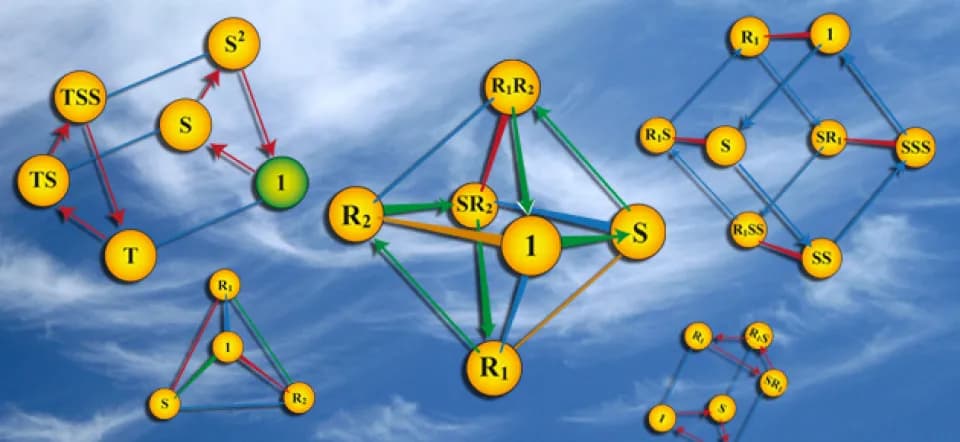
A finite group is completely determined by its multiplication table. If the group has order n, the table contains n2 entries. Once n is "not so small," discerning structures in such a table is no easy matter. Many groups have one or more generators—that is, a subset of the group whose various combinations, via the group operation, generate every element of the group. In this case, the British mathematician Arthur Cayley (1821−1895) used a graph to represent the group: the Cayley diagram.
He even used colors to distinguish the generators. Of course, a given group may have several diagrams, depending on the generators chosen.
Graphs and generators
---------------------
A Cayley diagram is a directed graph whose vertices are the elements of the group and whose edges represent the generators. At each vertex, there are two edges for each generator, one incoming and one outgoing. If vertex V is connected to vertex W by the directed edge S, this means that W = SV, with the group operation written multiplicatively, as Cayley did, and later William Burnside (1852−1927) and Harold Scott MacDonald Coxeter (1907−2003) did as well.