Sophus Lie and continuous transformation groups
------------------------------------------------------
The Norwegian Sophus Lie was born in 1842. His mother died when he was nine. Despite his imposing stature and uncommon physical strength, poor eyesight forced him to give up a military career. He instead pursued scientific studies at university, where Ludwig Sylow was among his teachers.
Lie discovered projective geometry through the works of Jean-Victor Poncelet (1788–1867) and Julius Plücker (1801–1868). At the age of 27, he received a scholarship to go to Berlin, where he met Felix Klein. They became friends and travelled together to Göttingen, then Paris. But it was 1870, and war broke out between Prussia and France. Klein returned to Berlin. After a series of twists and turns, Lie returned to Norway, where, after completing his doctorate in 1872, he obtained a professorship created especially for him. He remained there until 1886, when he left for Leipzig to succeed Klein, who had moved to Göttingen.
Many French students, particularly from the École normale supérieure, went to Leipzig to study the concept of a group with Lie. Lie himself visited France several times. Suffering from nervous depression, a broken man, he returned to Norway in 1898 and died the following year.
Following Galois's introduction of groups into algebra and Klein's into geometry, Sophus Lie brought these ideas into analysis by creating the theory of continuous transformation groups (now known as Lie groups) and all the techniques associated with them. He presented the theory in three volumes published between 1888 and 1893.
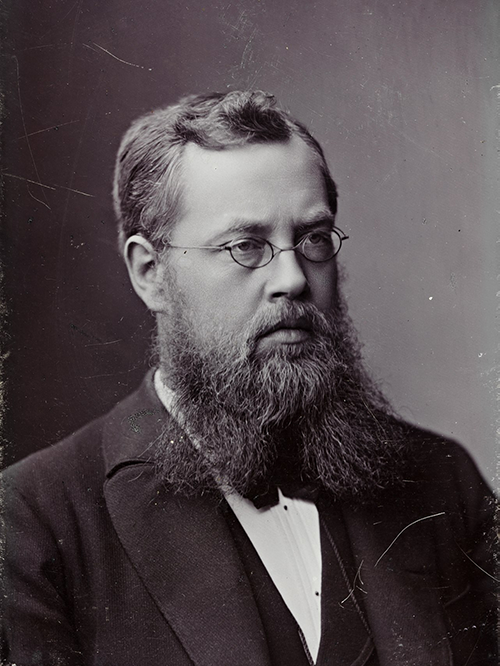
Sophus Lie.
At the crossroads of algebra and geometry
--------------------------------------------
A Lie group combines two a priori very different ideas: an algebraic structure—a group—and a notion from differential geometry—a manifold—that lets us discuss nearby elements, variations, and infinitesimal calculus… A set G equipped with a binary operation \ is called a Lie group if (G, \) is a group and can be endowed with a differentiable structure such that both group operations—namely, the operation \* and inversion—are differentiable.
One of the clearest examples is the group of rotations of the plane about a given point O. They can be represented by 2 × 2 matrices of the form where θ is any real number.
This set of rotations forms a group under composition: the composition of two rotations through angles θ and θ′ is the rotation through angle θ + θ′, while the inverse is the rotation through angle –θ. Both operations are differentiable on .
Applications in physics
------------------------------
Particle physics evolved over the course of the 20th century, but it is based primarily on the study of the symmetries that fundamental particles exhibit. These symmetries are described by continuous transformation groups. Such groups arise, for example, in quantum mechanics—in the work of Hermann Weyl and Eugene Wigner—and in relativity, following work by Henri Poincaré (see our special issue 79) and Hermann Minkowski. Somewhat provocatively, one could say that group theory has "invaded" modern theoretical physics.
Very often, the groups that arise in these various theories are Lie groups. Among them are the familiar classical groups, which are particular subgroups of the general linear group GL *n (), the group of invertible linear maps on , or of GLn*(), its counterpart over the complex numbers.
References:
• Les équations de la physique moderne. (The Equations of Modern Physics). Bibliothèque Tangente 71, 2019.
• Les invariants. (Invariants). Bibliothèque Tangente 47, 2013.
• Henri Poincaré, à la croisée des sciences. (Henri Poincaré at the Crossroads of the Sciences). Tangente special issue 79, 2021.