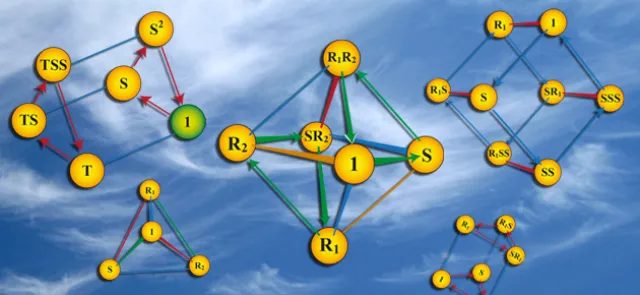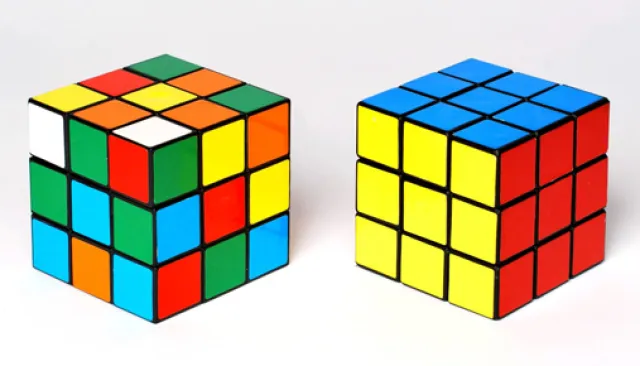
What does it mean to "leave an object unchanged" in geometry? A first answer suggests itself: "preserving distances". The transformations that preserve a given object can therefore only be isometries. That said, an arbitrary triangle has scarcely any symmetry other than the identity. The object in question must therefore possess a certain number of symmetries. To complete our investigation, we need to endow the set of isometries that leave the same object invariant with composition. Wonder of wonders, this will enable us to form a group.
To ease our way in, let's begin with a figure as elementary as the square. The case of the isosceles triangle was discussed in the article "Quotient structures".
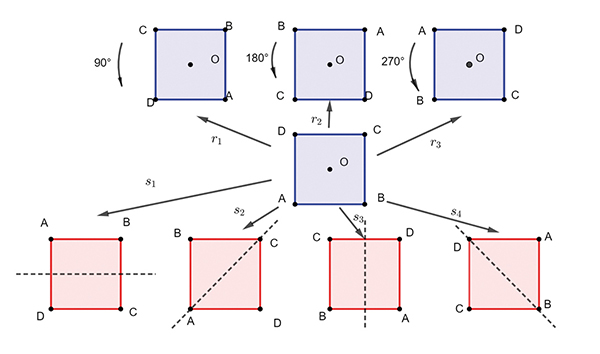
The isometries of a square.
A simple case: the square
-------------------------