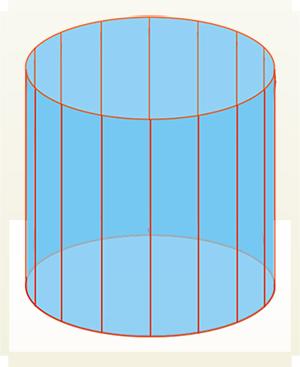
Imagine trying to construct a surface… from straight lines. The first ruled surface that comes to mind when we want to move beyond the plane is the cylinder, a kind of rolled-up plane. It can also be constructed using two wheels mounted on the same metal axle, with elastic bands stretched between them.
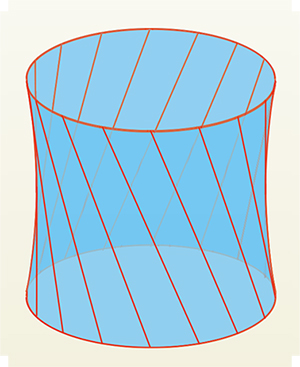
Simply turn one of the wheels—the top one, for example—to obtain a more surprising object. The elastic bands move, and a new surface appears. It bears the complicated name one-sheeted hyperboloid of revolution. In a suitably chosen orthonormal coordinate system, its equation has the form x2 + y2 – k2 z2 = 1, where k > 0 (the axis (Oz) is therefore the axis of the wheels, and the unit of length was chosen to simplify the equation).
Why such a name? Simply because it can also be obtained by rotating a hyperbola about one of its axes. If the same hyperbola is rotated about its other axis, the result is a surface with two parts, or two sheets. To distinguish these two very different surfaces, the number of sheets is always specified.