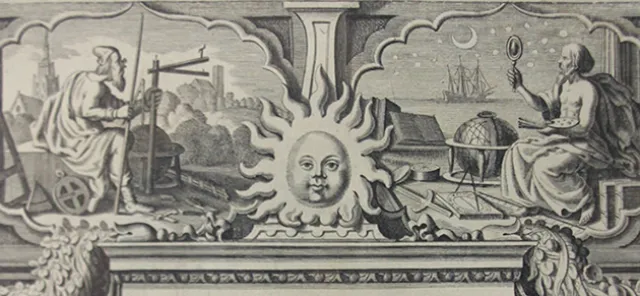
Mathematics as we know it today is universal. It can be understood in the same way by everyone: the truths it conveys are neither based on personal narratives nor revealed, but are all established through proofs constructed according to precise rules that everyone can understand. In this sense, mathematics is democratic! The emergence of proof went hand in hand with that of democracy in ancient Greece.
A decisive step in this direction came with Euclid's Elements.
-
A mysterious encyclopedist and teacher
----------------------------------------
Euclid had an immense influence on mathematics in general and geometry in particular: the elementary geometry still taught today owes much to him. Yet rather little is known about him: we know almost nothing of his family, education or teachers… Even his city of origin and the dates of his birth and death are not known precisely. In fact, the only known information about his life comes from commentaries on his work. Some of his successors call him Euclid of Alexandria. In a commentary on the Éléments, Proclus (412–485) noted that Euclid knew the work of Eudoxus (c. 408–c. 355 BC) and Theaetetus of Athens (c. 415–c. 369 BC), but was "older" than Archimedes (c. 287–212 BC) and Eratosthenes (c. 276–194 BC). From this information, we can estimate that Euclid was born around 330 BC and died around 275 BC. These dates remain highly uncertain.