One of the questions that occupied mathematicians until the 19th century was the theory of parallels as stated by Euclid (3rd century BC) in his Éléments (the Elements). This story is a fairly typical example of the judgments we can make a posteriori about proofs that we know, in light of new knowledge, to be certainly false, yet whose flaw is not so easy to find. It is also a typical example of those difficulties that become sources of discoveries or inventions opening new paths for mathematics. This is the story of the path that led from Euclidean geometry to the non-Euclidean geometries, which would be regarded as rather imaginary in their infancy, since they so thoroughly upended the notion of space.
Thus the French mathematician Adrien-Marie Legendre (1752-1833) believed he had proved the parallel postulate of Euclid's Éléments, caught in the trap of "self-evidence" despite all the precautions he took.
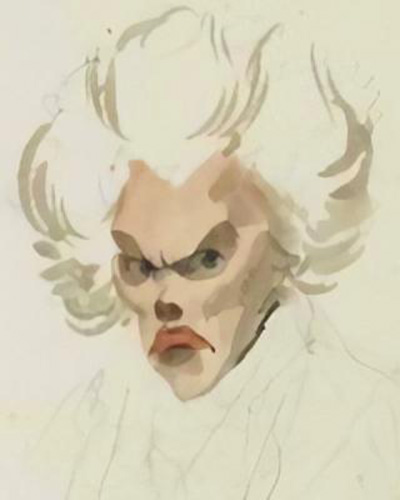
Caricature portrait of Adrien-Marie Legendre by Julien Léopold Boilly.
The parallel postulate
--------------------------