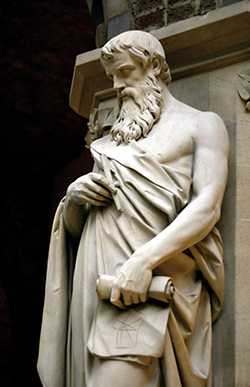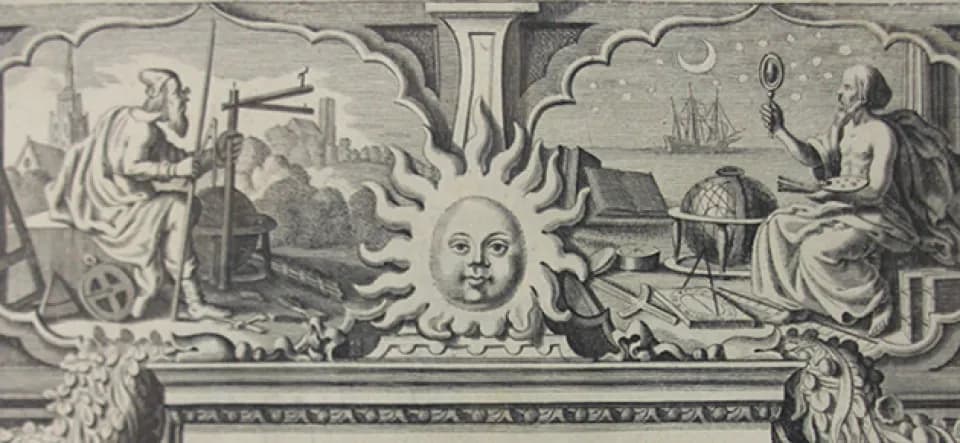
Statue of Euclid at the Oxford University Museum of Natural History.
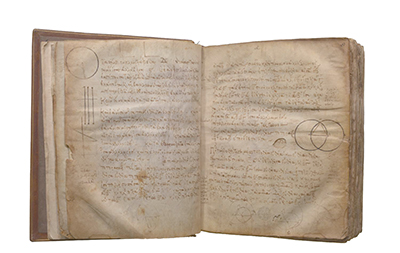
Two postulates in Euclid's Elements embody the ideal conception of the straightedge and compass inherited from Plato's realm of Ideas. The Alexandrian scholar built much of plane geometry—and the constructions he bequeathed to us—on these two postulates.


Articles recommended for you.

The so-called inscribed angle theorem, still part of every middle-school student's mathematical toolkit today, was already known to ancient geometers. It can sometimes have unusual applications.

Geometric constructions are central to reasoning in Euclid's The Elements. The various methods of teaching geometry, right up to the present day, claim to follow this approach.

Some profound results, such as Pythagoras' theorem, predate any awareness of mathematics as a science. Rather, once theorized and proved, these results gave rise to this science.

For two millennia, mathematicians sought to prove Euclid's fifth postulate. Adrien-Marie Legendre believed he had found a proof, before realizing that his proof implicitly assumed the truth of that same postulate. A circular argument…
Discussion
Sign in to post a comment and talk with other readers.
No comments yet. Be the first to respond.