The Thales' theorem may not be the one you think it is. Euclid had his own version, rigorously proved, concerning the relationship between an inscribed angle and a central angle. Later geometers made extensive use of their results, which spawned others, while craftsmen applied them to their drawings. And so the central angle and its double, the inscribed angle, entered the history of mathematics.
The other theorem of Thales
--------------------------
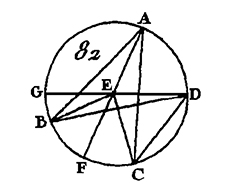
Figure from Louis's 1804 edition of Euclid's Éléments (translated by François Peyrard).
Astronomers, surveyors and geometers sought, from a very early date, to measure angles and compare them with one another. In ancient Egypt around 2500 BCE, and in ancient Babylon between 2000 and 1600 BCE, it was already known that a triangle inscribed in a semicircle was right-angled. But it was Thales, around 600 BCE, who provided a rigorous statement: every angle inscribed in a semicircle is a right angle. The first proof is also attributed to him. This comes as no surprise in Germany, where schoolchildren know the result as Thales' theorem. The historian Pamphila of Epidaurus, who lived under Nero and therefore much later, relates that Thales was so delighted by his discovery that he supposedly sacrificed an ox in thanks to the gods (the gods of mathematics?)… Other chroniclers claim that it was Pythagoras… Only one thing is certain: Thales brought logic to geometry. In particular, he introduced a different approach, treating angles as mathematical objects in their own right (see les Angles, Bibliothèque Tangente 53), and thereby proved many fruitful results.