On inscribed angles
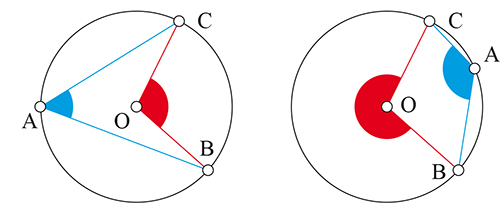
The inscribed angle theorem is one of the key results of elementary Euclidean geometry. It requires few tools to state—or even to prove—and has many consequences.


The inscribed angle theorem is one of the key results of elementary Euclidean geometry. It requires few tools to state—or even to prove—and has many consequences.


Articles recommended for you.

The so-called inscribed angle theorem, still part of every middle-school student's mathematical toolkit today, was already known to ancient geometers. It can sometimes have unusual applications.

The Greek mathematician, geographer and astronomer Claudius Ptolemy discovered a theorem about quadrilaterals inscribed in a circle in the second century CE. His result is certainly far less famous than that of his compatriot Pythagoras, but it is every bit as beautiful.

A sangaku was originally a Japanese wooden votive tablet. It sometimes bears an engraved geometric figure with the statement of a problem, together with the solution or sometimes a hint.

Some mathematical results are so vivid, so “concrete,” that they lend themselves beautifully to physical experiments. With a little ingenuity, they can even be “proved” physically! This is true of the Pythagorean theorem, the law of cosines and, indeed, triangle geometry as a whole.
Discussion
Sign in to post a comment and talk with other readers.
No comments yet. Be the first to respond.