On the one hand, we have mathematical theorems: provable propositions derived from other statements that have already been proved or accepted without proof, such as axioms or postulates. On the other, physics is a science that studies the fundamental properties of matter and space-time through experimentation and the development of concepts; a physical law models and predicts a natural phenomenon. By combining these two viewpoints, a physical law can sometimes “prove” a mathematical result!
-
Three points—that’s all…
-------------------------
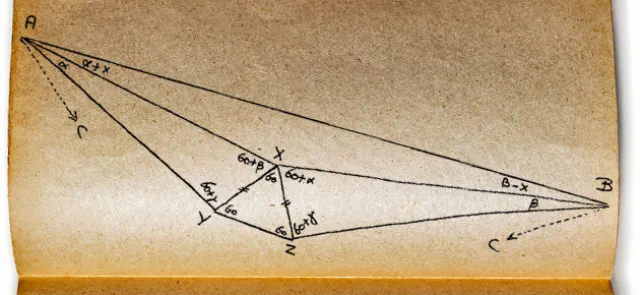
In 1636, the French magistrate and mathematician Pierre de Fermat (c. 1601–1665) applied an analytical technique he had developed, known as the method of maxima and minima, to solve the following problem: Given three points, find a fourth for which the sum of the distances to the three given points is as small as possible.
Four years later, the Italian physicist and mathematician Evangelista Torricelli (1608–1647) provided the first geometric answer. Using the properties of ellipses, he proved that the fourth point had to be the common point of three circles, now known as Torricelli circles.