



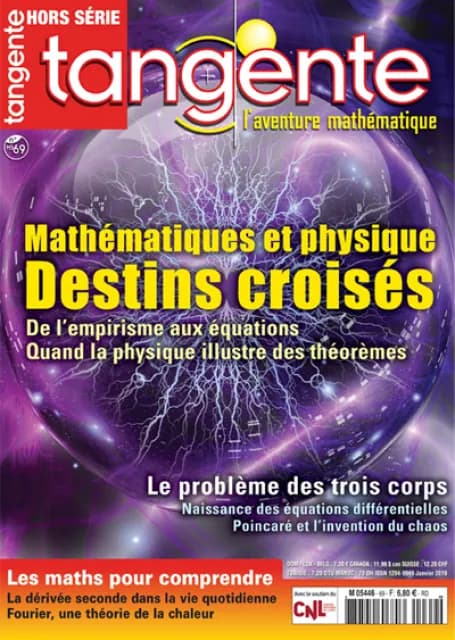
Maths et Physique
This issue is not fully translated into English yet; only translated content is shown.
Read the French versionAll folders in this issue

What mathematics owes to physics...and vice versa
In the history of the development of scientific thought, it is often difficult to distinguish what belongs to mathematics from what is initiated by physics. Scholars rarely confined themselves to a single field at that time. The role of mathematics then evolves, as the physicist changes paradigm: calculation tool, reservoir of models, predictive instrument… From the method of exhaustion already used by Archimedes to the Fourier and Maxwell equations, the examples to explore are numerous.

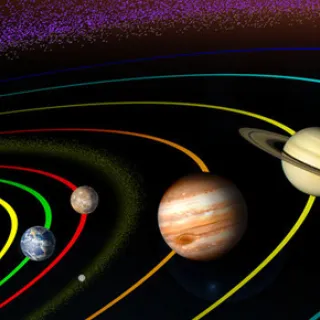
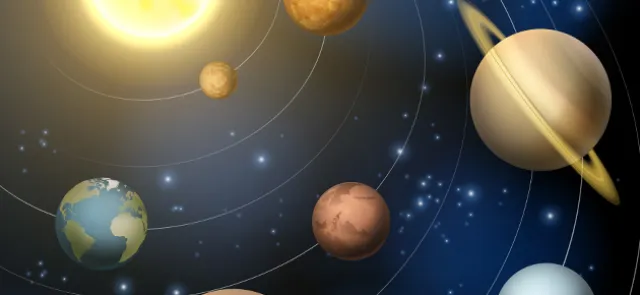
From observing nature to mathematical thinking
The study of the movement of celestial bodies illustrates the transformation in the physicists' relationship to mathematics. After Newton's synthetic method, Lagrange's analytical method, exploiting the power of integral calculus, gave rise to the theory of differential equations. A century later, under the inspiration of Henri Poincaré, the same problem will carry the beginnings of dynamical systems.
All articles in this issue

Finding your position at sea
On Earth, a position is identified by two coordinates: latitude and longitude. Finding your position means determining these two values.

Applications of the second derivative
The concept of acceleration corresponds to a second derivative. It therefore seems only natural that a mathematical concept as sophisticated as the derivative should have concrete applications. Such applications arise in questions involving the profiles of roads and railway tracks.
When physics “proves”
Some mathematical results are so vivid, so “concrete,” that they lend themselves beautifully to physical experiments. With a little ingenuity, they can even be “proved” physically! This is true of the Pythagorean theorem, the law of cosines and, indeed, triangle geometry as a whole.

Physics on one side, mathematics on the other?
It would be misleading to regard mathematics and physics as entirely separate disciplines, given the many exchanges and interactions between them. Mathematical physics is, moreover, a nonempty intersection of the two.

Differences in notation: are mathematicians and physicists irreconcilable?
The differences between physicists' and mathematicians' notation might seem like mere turf wars, and thus reconcilable with a little common sense. There are several reasons for these differences
A new definition of the International System of Units
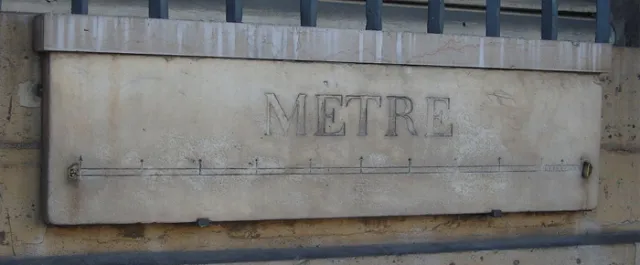
The conference held in Versailles in November 2018 changed four units of measurement, including the kilo. These new units will no longer depend on specific experiments. Their definitions will take effect in May 2019. What better opportunity to look back at the origins and evolution of our units of measurement?