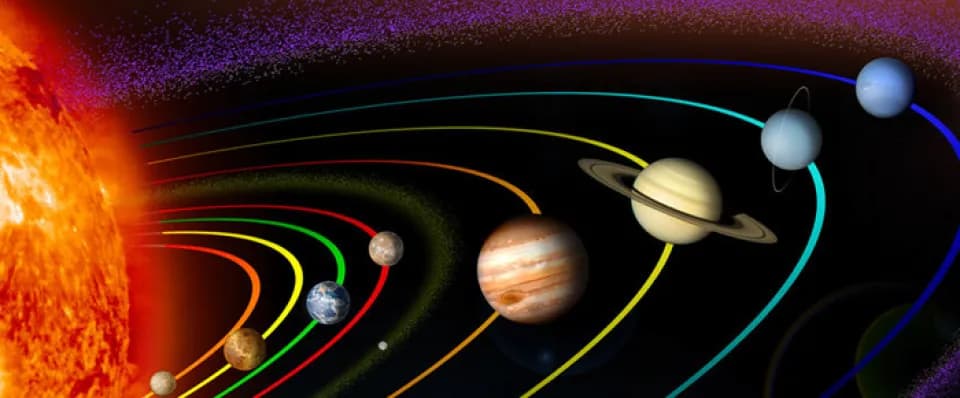
Tycho Brahe's astronomical measurements (1546–1601), remarkably precise for their time, were interpreted by Johannes Kepler (1571–1630), who used them to derive his laws of planetary motion around the Sun. To do so, he used ellipses, curves known since antiquity, obtained by intersecting a cone with a plane.
-
Flower beds in space
-------------------------------------
To describe Kepler's first law, we use a property of ellipses that also makes them easy to draw. In a very different setting, they are ideal curves for flower beds: attractive and easy to lay out! All that is needed is three stakes and a rope. Plant two stakes and attach the rope to them, leaving it slack. Then hold the third stake and pull the rope taut. As this movable stake travels around the two fixed stakes, it traces an ellipse whose foci are the fixed stakes. A circle is therefore an ellipse whose two foci coincide.