Gauss and geometrical optics
----------------------------
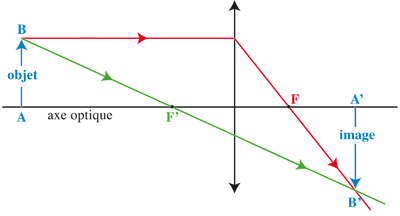
Mathematicians know Gauss as… a mathematician. But much of his research also ventured into physics. We owe him significant discoveries in electricity (Kirchhoff's law), optics and electromagnetism (Maxwell's equations). His research in optics rests on what is now known as the Gaussian approximation. Broadly speaking, spherical lenses are treated as objects with no thickness, represented by line segments whose perpendicular bisector is drawn: the optical axis. Only rays that make a small angle with this axis and remain close to it are considered. The lenses are assumed to be stigmatic (the image of a point is a point) and aplanatic (the image of an object perpendicular to the optical axis is itself perpendicular to the optical axis). To construct the image of a point P, it is then enough to consider two rays from P; all the other rays from P will pass through the image point. Crude though it may appear, this approximation is often applicable in practice and greatly simplifies the mathematical relationships of geometrical optics.
-
Choice of model, solution method…
------------------------------------------