Shortly before 1900, at a physics meeting in London, William Thomson, better known as Lord Kelvin, declared that "physical science today forms, for the most part, a perfectly harmonious and virtually complete whole." Many agreed with him: as the century drew to a close, physical science seemed to have made immense progress and reached a kind of unifying culmination. From thermodynamics and mechanics to electricity and optics, everything appeared reducible to a single system of equations, as James Clerk Maxwell had achieved with electromagnetism, his synthesis of magnetism, electricity and optics. Lord Kelvin continued: "Two small dark clouds remain to obscure the picture." These were the negative result of the Michelson–Morley experiment (see FOCUS) and the failure to recover the "law of black-body radiation" experimentally.
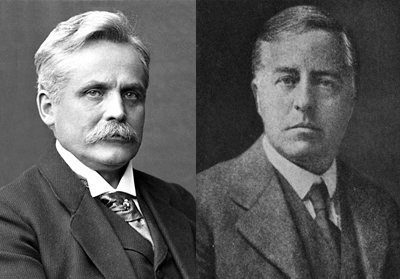
Left: Wilhelm Carl Werner Otto Fritz Franz Wien (1864–1928), winner of the 1911 Nobel Prize in Physics for his discoveries concerning the laws of heat radiation.
Right: James Hopwood Jeans (1877–1946).
Two dark clouds
=====================================================================