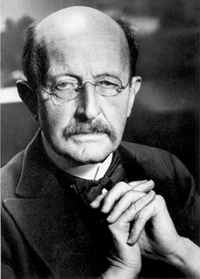
Opposite: Max Karl Ernst Ludwig Planck (1858–1947).
In 1900, Max Planck hypothesized that energy is exchanged discontinuously between matter and light. Five years later came Einstein's annus mirabilis, when he published four papers that laid the foundations of modern physics. In chronological order, they dealt with quantum theory, Brownian motion, special relativity and the mass–energy relation.
In the first paper of that remarkable year, for which Einstein received the 1921 Nobel Prize in Physics, he took up Planck's idea by interpreting the photoelectric effect in terms of light quanta: photons. This marked the beginning of quantum theory, which seeks to understand nature on the atomic scale, beyond the reach of our senses.
In 1926, two equally effective forms of quantum mechanics coexisted: the wave mechanics of Louis de Broglie and Erwin Schrödinger, and Werner Heisenberg's matrix mechanics. Schrödinger and Dirac soon showed that the two approaches were physically and mathematically equivalent, but it was John von Neumann who devised a unified formulation of the theory in his book Les Fondements mathématiques de la mécanique quantique, published in 1932.