If you have understood quantum physics, it's because it was explained to you badly. This aphorism, well known in the "field," is not cited here to let this writer off the hook. More prosaically, it reflects the debates and controversies stirred up by the seemingly contradictory discoveries of the years 1880–1920. This article, moreover, without letting you understand quantum physics (four pages are obviously far too few for that), will at least let you perceive that things are more complicated and more mathematical than is generally believed.
Wave-particle duality: a chaotic history
-----------------------------------------------------
Let's take two examples: the photon and the electron. These two objects are, on the face of it, very different: the photon, for instance, is massless, unlike the electron. If you took the physics-chemistry specialty in your final year of high school, you'll necessarily have some ideas about it.
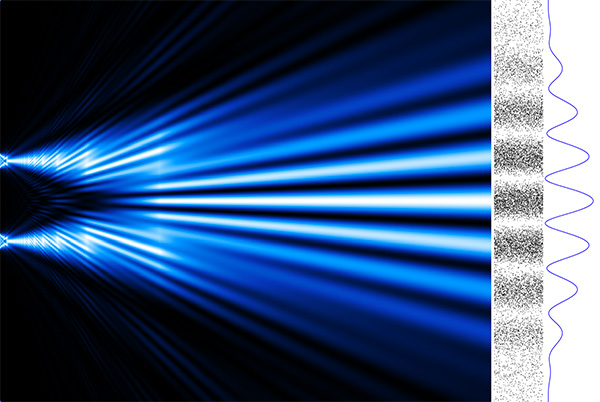
Experiments in the 19th century indicated that light has a wave-like character, patently shown in Thomas Young's (1773-1829) famous double-slit diffraction experiments, in which a beam of light, passing through two slits, produces the image of two crossing wave trains (interference) on a screen behind them. This 1802 experiment was spectacularly confirmed by François Arago (1786-1853), then theoretically presented by James Clerk Maxwell (1831-1879). Until 1880, then, the status of the photon was clear: it was a wave. The electron, by contrast, displayed all the features of a particle.